Cycle Syncing Tea Set for Irregular Cycles: How to Start






Written & Reviewed by: Dr. Sarah Jenkins, MD, FACOG | September 17, 2026
Dr. Sarah Jenkins, MD, FACOG
Board-certified OB-GYN & Women's Hormonal Health Specialist. Dr. Jenkins focuses on menstrual cycle health, perimenopause, and evidence-based botanical wellness. All content is reviewed for clinical accuracy and FTC compliance.
A cycle syncing tea set can feel confusing when your cycle does not follow a neat 28-day pattern. You do not need to force your body into a fixed calendar. You can use the set as a flexible beverage routine while keeping medical questions separate.
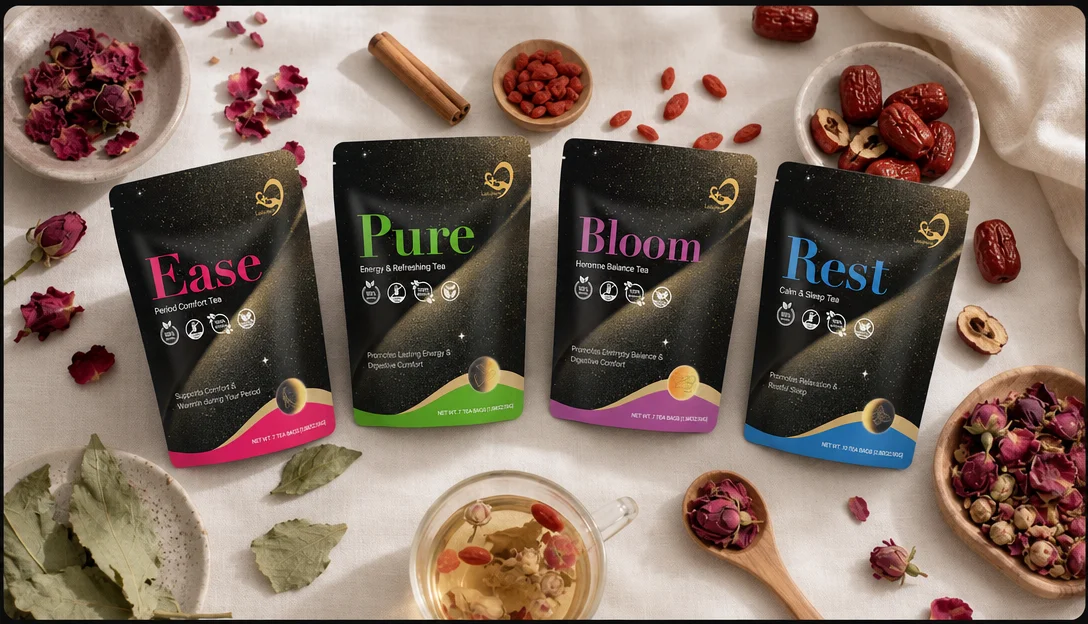
Laicuherb's Cycle Tea Set is described as four phase-positioned herbal blends: Ease, Pure, Bloom, and Rest. Each blend is intended for brewing and drinking only. The set may help you create a simple daily ritual, but it cannot identify a hormone phase, make an irregular cycle regular, or explain why your timing has changed.
That distinction matters. A flexible tea routine may offer comfort and structure during an unpredictable month. It is an everyday support choice, not a substitute for professional care.
This guide reflects general nutritional research and traditional botanical literature. It does not replace professional medical consultation.
Contents
- → Quick Answer: Follow Observed Phases, Not a Fixed Calendar
- → What Makes a Cycle Irregular?
- → Tracking Signals — and Their Limits
- → How to Choose a Starting Blend?
- → How to Switch Blends When Timing Is Uncertain?
- → A Simple Cycle-and-Tea Tracking Template
- → When Irregular Cycles Need Medical Evaluation?
- → Conclusion
- → Try the Laicuherb Cycle Tea Set
- → FAQ
Quick Answer: Follow Observed Phases, Not a Fixed 28-Day Calendar
If your cycles vary, do not assign each tea to a calendar day and assume the schedule will fit every month. Use the product's phase positioning as a routine framework, and treat body observations as clues rather than diagnoses.
Ease
Menstrual Phase
Longan, red dates, wolfberry, angelica, dried ginger, roses, peony petals
Caffeine-free
Pure
Follicular Phase
Lotus leaf, cassia seed, moringa, mulberry leaf, green tea
Contains caffeine (green tea)
Bloom
Ovulatory Window
Rose, ginger, wolfberry, brown sugar, red dates
Caffeine-free
Rest
Luteal Phase
Cinnamon, nettle leaf, raspberry fruit, ginger, spearmint, lemongrass, ashwagandha
Caffeine-free
Ease is described for the menstrual phase. Pure is described for the follicular phase. Bloom is described for the ovulatory window. Rest is described for the luteal phase [1]. If you are bleeding, Ease may be the blend that matches the current routine even if the bleeding started earlier or later than an app predicted. If you are unsure which phase you are in, it is also reasonable to pause and ask a healthcare professional rather than guessing.
The teas in the set are not intended to control cycle timing, restore regular ovulation, or change PCOS or perimenopause-related symptoms. Their role is modest: choose a drink that fits the moment without treating the tea as a hormone or cycle intervention.
What Makes a Cycle Irregular?
"Irregular" can describe several different patterns. Some cycles may be consistently shorter than 21 days or longer than 35 days. Others may vary widely from one cycle to the next [2][6]. A cycle that arrives on day 26 one month and day 40 the next is different from a stable 40-day pattern, but both may be worth discussing if the change is new, persistent, or affecting your health.
Stress, travel, sleep disruption, changes in weight, intense exercise, illness, medications, thyroid conditions, PCOS, pregnancy, and perimenopause can all be part of the picture [3][4][5]. Perimenopause is one possible cause of changing cycles, but it is not an automatic explanation, especially in younger people.
An irregular calendar does not prevent you from using the four teas as optional comfort drinks. The set simply needs to stay in its lane. You can select a blend individually, but choosing a tea by mood or symptom does not tell you why the cycle changed or indicate that the tea caused a biological effect.
Tracking Signals That Are Useful — and Their Limits
Tracking can help you notice patterns, but no single symptom reliably identifies every menstrual phase [1][7]. You might record bleeding, cervical mucus, sleep, energy, breast tenderness, bloating, cramps, mood, and the tea you drank.
Stretchy, slippery, egg-white-like cervical mucus can occur near the fertile window, but it is not proof that ovulation happened. Stress, medication, hormonal contraception, infection, semen, lubricants, and individual variation can change mucus. BBT and urinary LH tests can add information for people who use them, but they also have limits and should not be replaced by a tea ritual.
Bloom is described as the ovulatory-window blend and includes rose, ginger, wolfberry, brown sugar, and red dates according to the supplied product information. Those ingredients have not been established here as a way to raise LH, trigger ovulation, or improve fertility. If you are unsure which tea matches the phase, record the uncertainty rather than turning a guess into a medical conclusion.
How to Choose a Starting Blend?
Start with the blend that matches the phase you can actually observe, not the phase an app predicts with confidence it has not earned. If you are bleeding, Ease is the set's menstrual-phase option. The supplied ingredient description includes longan, red dates, wolfberry, angelica, dried ginger, flowers or roses, and peony petals.
If bleeding has ended and you are moving into the next part of your cycle, Pure is described for the follicular phase. Its supplied ingredient list includes lotus leaf, cassia seed, moringa, mulberry leaf, and green tea. Because green tea contains caffeine, consider your caffeine sensitivity and sleep routine.
If you notice signs that may occur near the fertile window, Bloom is the ovulatory-phase option. If you are in the later part of a cycle and notice tension, bloating, breast discomfort, or sleep changes, Rest is described for the luteal phase. Its supplied ingredients include cinnamon, nettle leaf, raspberry fruit, ginger, spearmint, lemongrass, and ashwagandha.
These are product-positioning descriptions, not medical phase tests or treatment instructions. If no phase is clear, you do not need to force a choice. A simple caffeine-free comfort option or a clinician's advice may be more appropriate.
How to Switch Blends When Timing Is Uncertain?
You do not need to finish one box before opening another. Use one blend while it fits the routine, then switch when the phase or symptom pattern changes clearly. Return to Ease when bleeding begins again. Move toward Bloom only when you have observations that make the ovulatory window plausible, not because a calendar insists on a specific day.
Some cycles may not show every phase clearly. You might not detect fertile-quality mucus. You might have a long follicular phase. You might experience bleeding after a period of uncertainty. A skipped or unclear phase is a tracking detail to record, not evidence that the tea caused or failed to cause anything.
Keep a note of why you switched. "Started bleeding," "sleep changed," or "uncertain phase" is more useful than "tea balanced hormones." The note describes your routine; it does not prove that the tea caused the change. Product questions can go to Laicuherb at hello@laicuherb.com. Questions about absent ovulation, fertility, PCOS, or persistent irregularity belong with a healthcare professional.
A Simple Cycle-and-Tea Tracking Template
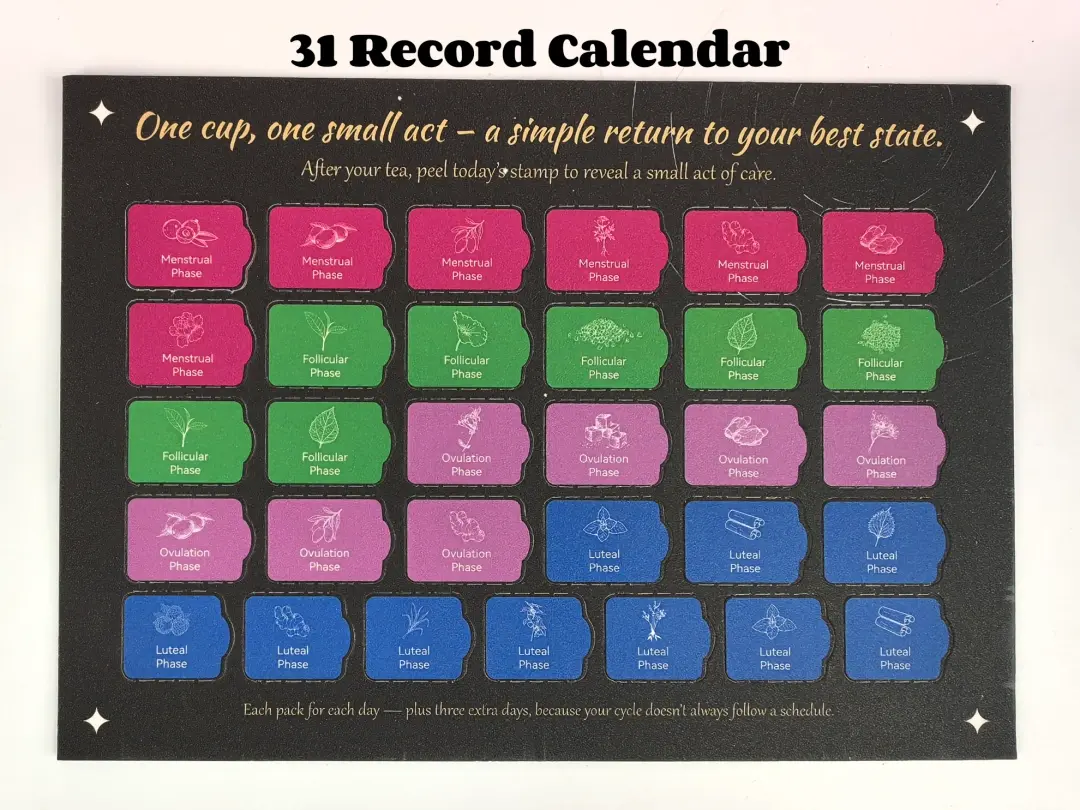
The supplied product image shows that the Cycle Tea Set comes with a 31 Record Calendar. The calendar's daily stickers correspond one-to-one with the specific tea products included in the set and are grouped under Menstrual Phase, Follicular Phase, Ovulation Phase, and Luteal Phase. After drinking the corresponding tea, you can peel the sticker for that day to reveal a small act of care and mark your progress through the set.
This is a product-use calendar, not a generic blank date tracker. The phase labels help you follow the tea arrangement included in the set, while the stickers make each day's tea ritual visible. They do not diagnose an irregular cycle, confirm ovulation, or show that the tea caused a hormonal change.
You can add brief notes beside the calendar when useful, such as bleeding, sleep changes, travel, stress, medication changes, or symptoms. If you use cervical-mucus observations, BBT, or LH tests, keep those measurements separate from the tea stickers. The calendar records your tea use; it does not replace clinical evaluation or fertility tracking.
After two or three cycles, your notes may show patterns that a fixed date schedule misses [2][7]. They still do not diagnose the cause of irregularity. Bring the calendar and any separate tracking records to a clinician if the pattern is new, persistent, or worrying.
When Irregular Cycles Need Medical Evaluation?
A cycle syncing tea set can be part of daily comfort, but it should not delay an evaluation. Consider medical care if cycles are repeatedly shorter than 21 days or longer than 35 days, vary substantially from month to month, or change suddenly after being predictable [2][6].
Seek care if you miss three periods in a row and are not pregnant, have very heavy bleeding, bleed between periods or after sex, experience severe pain, or have symptoms that interfere with normal life [3][5][8]. If pregnancy is possible, take an appropriate pregnancy test and contact a healthcare professional for advice about bleeding or pain.
- Cycles repeatedly shorter than 21 days or longer than 35 days
- Cycles vary substantially from month to month, or change suddenly after being predictable
- Three or more missed periods in a row when not pregnant
- Very heavy bleeding, bleeding between periods, or bleeding after sex
- Severe pelvic pain, or symptoms that interfere with normal life
- Pregnancy is possible and you have pain, bleeding, or concerns
These patterns can have many explanations, including PCOS, thyroid conditions, perimenopause, pregnancy, medication effects, stress, or other gynecologic causes. This article does not diagnose PCOS, anovulation, perimenopause, or any other condition. A clinician may need your history, examination, testing, or imaging to understand what is happening.
The tea can remain a beverage while you wait for care. It should not be used to explain away an abnormal pattern or replace professional guidance.
Conclusion
A cycle syncing tea set can make an irregular month feel less rigid when you use it as a flexible drink routine. Ease, Pure, Bloom, and Rest can be selected according to the phase you can reasonably observe, but none of them confirms a phase or changes the cycle that produced it.
Track simple signals. Record the tea separately. Use the set for ritual and daily comfort, not for hormone assessment, fertility decisions, or cycle management. When bleeding, pain, missed periods, or repeated irregularity needs attention, bring your notes to a qualified healthcare professional.
Try the Laicuherb Cycle Tea Set
The Laicuherb Cycle Tea Set brings together four individually positioned blends: Ease, Pure, Bloom, and Rest. Use the set as a flexible beverage routine when calendar days do not tell the whole story. Choose based on the phase you can reasonably observe, record what you drank, and remember that the tea is not evidence of hormone balance or a corrected cycle.
For questions about ingredients, brewing, or choosing a starting blend, contact Laicuherb at hello@laicuherb.com. If you have persistent irregularity, heavy bleeding, severe pain, missed periods, or pregnancy concerns, speak with a qualified healthcare professional first.
Frequently Asked Questions
Can I use the Laicuherb Cycle Tea Set if I have PCOS?
This article does not diagnose PCOS or present any tea as a way to manage it. If you have a PCOS diagnosis, ask your healthcare provider whether an herbal tea routine fits with your care plan, medicines, pregnancy goals, and caffeine intake. The set can be used as a beverage only if it is appropriate for your individual situation.
Is the Cycle Tea Set suitable during perimenopause?
Perimenopause can make cycles less predictable, but not every irregular cycle is caused by perimenopause. If your symptoms are new, severe, or difficult to interpret, seek medical advice. The teas are intended for drinking and are not a way to manage perimenopause, hot flashes, irregular bleeding, or other medical symptoms.
What should I do if I miss a period while using the Cycle Tea Set?
If pregnancy is possible, take an appropriate pregnancy test and contact a healthcare professional if you have pain, bleeding, or concerns. Stress, travel, illness, weight changes, medication, PCOS, thyroid conditions, and perimenopause can also affect timing. Missing three or more periods in a row when not pregnant warrants medical evaluation. An app can record the missed period, but it cannot identify the cause.
References
[1] Reed BG & Carr BR. The normal menstrual cycle and the control of ovulation. Endotext. MDText.com, Inc. https://www.ncbi.nlm.nih.gov/books/NBK279054/
[2] Bull JR et al. Real-world menstrual cycle characteristics of more than 600,000 menstrual cycles. npj Digital Medicine, 2, 83. https://doi.org/10.1038/s41746-019-0152-7
[3] Harlow SD & Paramsothy P. Menstruation and the menopausal transition. Obstetrics and Gynecology Clinics of North America.
[4] Baker FC & Lee KA. Menstrual cycle effects on sleep. Sleep Medicine Clinics.
[5] Santoro N. Perimenopause: From research to practice. Journal of Women's Health.
[6] Chiazze L et al. The length and variability of the human menstrual cycle. JAMA.
[7] Soumpasis I et al. Real-life insights on menstrual cycles and ovulation using big data. Human Reproduction Open.
[8] American College of Obstetricians and Gynecologists. Abnormal uterine bleeding. ACOG patient guidance. https://www.acog.org/womens-health/faqs/abnormal-uterine-bleeding