Feminine Moisture Supplement Research: How to Read Study Timelines






Contents
- → Quick Answer: Trial Duration Is Not a Personal Results Deadline
- → Study Duration, Follow-Up, and Time-to-Effect Are Different Measures
- → Which Oral Sea Buckthorn Studies Are Relevant
- → How Participants, Controls, and Outcomes Shape Interpretation
- → Why Ingredient Research Does Not Automatically Validate a Finished Supplement
- → How to Discuss Expectations Without Promising a Timeline
- → A Reader Checklist for Evaluating ‘Works in X Weeks’ Claims
- → Conclusion
- → FAQ
This article is not a promise of results in X weeks. It is a reading guide: how to tell study duration from follow-up, follow-up from time-to-effect, and ingredient research from the bottle on the shelf.
You go online looking for omega-7 and sea buckthorn for intimate dryness, and the same line keeps showing up: “clinical studies showed improvement in just six weeks,” or “participants noticed changes within eight weeks.” Numbers feel scientific. When dryness is real—after menopause, during perimenopause, after birth, or as a medicine side effect—a calendar date can look like relief with a due date.
That is the trap. A study timeline is not your personal deadline. The length of a trial is the window researchers chose to watch participants. It does not tell you when a finished feminine moisture supplement will “kick in,” or whether it will.
Laicuherb’s Feminine Moisture Support is a non-hormonal vegan daily softgel made with whole Himalayan sea buckthorn berry extract. The formula provides omega-3, omega-6, omega-7, omega-9, vitamin A, vitamin E, plant sterols, and natural carotenoids.
Quick Answer: Trial Duration Is Not a Personal Results Deadline
The most common mistake in supplement research is treating trial length as a forecast of how long a product will take to work in your body. If a paper says outcomes were assessed at twelve weeks, that means the protocol ran for twelve weeks. It does not mean change began at week twelve. It does not mean every participant responded. It does not mean a different oil, dose, or life stage will follow the same clock.
Investigators pick duration for reasons that have little to do with your calendar: the biology they hope to observe, the measures they can collect, the budget, and the visit schedule. Some people in a group may notice a shift earlier. Others may notice nothing that a questionnaire or a clinic score can capture.
If you take Laicuherb’s sea buckthorn oil softgel, that distinction protects you from two opposite errors. One is quitting too soon because a blog sold you a six-week miracle. The other is staying on a product indefinitely because a study number felt like a guarantee. The label remains the reference for daily use. Your own record over time, plus a clinician’s view if dryness is persistent or painful, remains more relevant than a marketing countdown.
Study Duration, Follow-Up, and Time-to-Effect Are Different Measures
Three numbers get mixed together in almost every “works in X weeks” claim. They are not interchangeable.
Study duration is the span from the first dose to the last planned visit. Follow-up is when the last data point is collected. That may be the last day of dosing, or later. Time-to-effect is the first point at which the active group differed from the comparison group on a pre-specified measure in a way the statistics can support. Those three clocks can disagree.
A twelve-week trial can find a difference only at week twelve because that is the only analysis time. It can also find a difference at week four, or none at week four and a difference at week eight. Many papers report only the final endpoint and let the reader invent a start date. Time-to-effect is the number people actually want when they shop for a feminine moisture supplement. It is also the number least often reported with enough visits to be trusted.
| Measure | What it tells you | What it does not tell you |
|---|---|---|
| Study duration | How long the trial lasted | When a change began |
| Follow-up point | When the last data were collected | Whether an earlier change existed |
| Time-to-effect | When the groups first differed on a specified measure | Whether every person responded at that visit |
Read those figures as ranges and windows, not as appointments on your calendar.
Which Oral Sea Buckthorn Studies Are Relevant
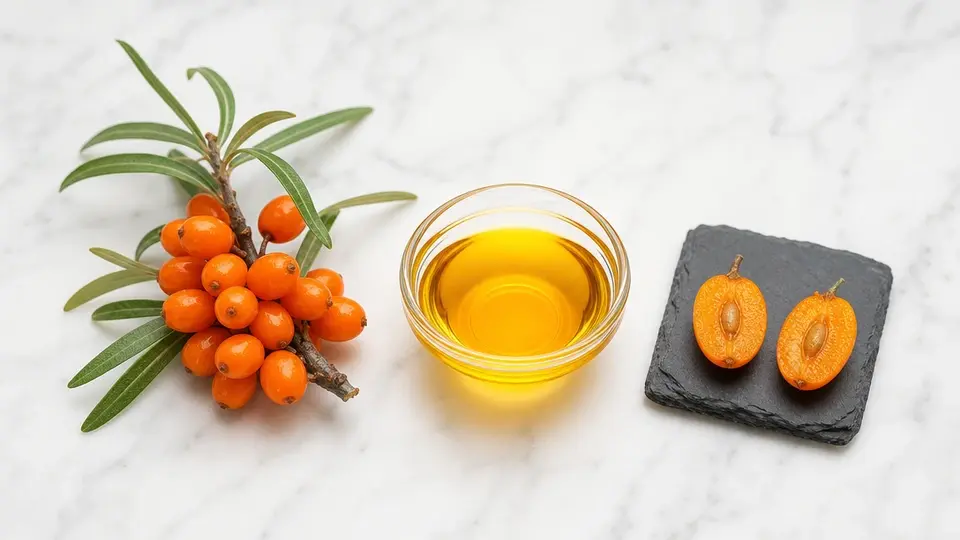
Not every sea buckthorn paper is useful for judging a feminine moisture supplement. Oils have been studied for circulating lipids, skin lipids, composition, and other outcomes. Relevance depends on what was measured, in whom, at what daily amount, and in what form.
The study most often used in this conversation is Larmo et al. (2014) in Maturitas. It was a randomized, double-blind, placebo-controlled trial in postmenopausal women with vaginal dryness, itching, or burning. One hundred sixteen women were randomized. Ninety-eight completed three months of 3 g per day of sea buckthorn oil or placebo oil. At the start and the end, a gynecologist scored vaginal health, and vaginal pH and moisture were measured. Symptoms were also logged [1].
That design is relevant because it used oral sea buckthorn oil in women with intimate dryness symptoms. It is not a blank check. The statistically clearer finding was a better rate of improvement in vaginal epithelial integrity versus placebo when all randomized participants were included. Vaginal health index showed only a trend. Moisture and dryness symptoms were collected; they should not be rewritten as a proven “moisture in X weeks” result.
Composition papers still have a job. Yang and Kallio (2001) mapped how sea buckthorn berry lipids vary by origin [2]. Zielińska and Nowak (2017) reviewed the active constituents of the oil [3]. Those papers help you understand why two “sea buckthorn” labels can differ. They do not measure vaginal moisture, and they do not supply a personal timeline.
Specificity is the filter. The closer a paper is to your life stage, the oral route, the dose, and the outcome you care about, the more the timing data are worth. The farther it sits from those four points, the more it is background, not a deadline.
How Participants, Controls, and Outcomes Shape Interpretation
Timeline data are attached to a population, a comparison, and a measurement method. Move any of those three, and the clock moves with them.
Larmo enrolled postmenopausal women. A result at three months in that group is a three-month result in that group. It is not automatically the timetable for a perimenopausal woman in her forties or a postpartum woman in her twenties. Hormone status, baseline mucosal condition, other medicines, and diet are not noise around the study. They are part of the setting that produced the number.
The control arm matters as much as the oil. A placebo softgel asks whether sea buckthorn oil did more than the act of taking a daily capsule. A trial with no comparison mixes the ingredient with expectation, attention, and time. That mix can look like a “fast” result and still tell you nothing about the oil.
Outcome choice changes what “worked” even means. A clinician score of epithelial integrity can move before a woman feels wetter. A moisture device can disagree with a symptom diary. A diary can move while a clinic score does not. Larmo measured several of these at once, which is why it is a mistake to flatten the paper into a single moisture promise [1].
A study schedule is a product of those choices. It is not a universal forecast for every feminine moisture supplement.
With those tools in hand, the next question is why even a careful ingredient trial does not automatically validate the finished bottle. For questions about Laicuherb’s Feminine Moisture Support formulation, sourcing, or certifications, the team can be reached at hello@laicuherb.com.
Why Ingredient Research Does Not Automatically Validate a Finished Supplement
This is where proof literacy either holds or collapses.
A trial can support a specific oil, at a specific daily amount, in a specific group, under a specific protocol. Larmo’s sea buckthorn oil, at 3 g per day, in postmenopausal women, for three months, is that kind of evidence [1]. It is not evidence that every feminine moisture supplement containing sea buckthorn will behave the same way, on the same clock, for the same person.
Oil composition varies
Sea buckthorn oils are not one substance. Fatty-acid profiles change with the plant part (seed, pulp, or whole berry), origin, altitude, and extraction method [2][3]. Laicuherb’s Feminine Moisture Support uses whole-berry CO2-extracted Himalayan sea buckthorn oil. That is a particular composition. It may or may not be the oil in any given trial.
Dose may not match
The amount swallowed in a protocol may not match the amount on a retail label. Compare the label in your hand with the protocol before drawing timing conclusions.
Finished softgel complexity
A finished softgel is more than the oil: capsule material, storage, and manufacturing quality can all affect what you actually absorb. None of that proves the supplement is empty. It proves that an ingredient study is a basis for questions, not a blanket confirmation of the product.

How to Discuss Expectations Without Promising a Timeline
"How long does a feminine moisture supplement take to work?" is the question every honest answer has to refuse to date-stamp.
The honest reply is that it depends on facts no blog can know for one person: hormone status, baseline mucosal health, dietary fat (which affects absorption of fat-soluble constituents), how consistently the serving is taken, other medicines, and ordinary biological variation. Group means from a three-month trial are group means. They are not a personal forecast.
Larmo assessed vaginal health at the beginning and the end of three months, and symptoms were logged during the study. That design gives a three-month window. It does not give a validated week-six or week-twelve start date for moisture, and it does not promise that you will notice a change on either of those dates [1].
The usable advice is narrower. Follow the label. Give daily use enough consistent weeks to be a fair observation, without turning a study duration into a money-back clock. Some people may notice a shift sooner, later, or in a way a trial never measured. Some may notice nothing that matters to them. Current research does not support a guaranteed timetable for any feminine moisture supplement, and this article does not offer one.
If dryness is new, severe, painful, or paired with bleeding, unusual discharge, or urinary symptoms, that is a clinical conversation, not a supplement-timing conversation.
A Reader Checklist for Evaluating ‘Works in X Weeks’ Claims
When a page says “clinically shown to improve moisture in eight weeks,” walk the claim before you let it set your expectations.
Ask whether a specific study is named, or whether the line is generic marketing.
Ask who was enrolled, and whether that age, menopausal status, and symptom profile look like yours.
Ask what daily amount and what oil were used, then compare those facts with the label in your hand.
Ask whether the result was a symptom diary, a moisture reading, a pH value, or a clinician score of tissue.
Ask whether the advertised number is study duration, follow-up, or a true time-to-effect with more than one analysis visit.
Ask how large the effect was. Statistical significance can describe a small practical change.
Ask whether there was a placebo. Without one, you cannot separate the capsule habit from the oil.
This checklist does not make you a trialist. It makes you harder to rush, which is the better position for choosing any feminine moisture supplement.
Conclusion
Feminine moisture supplement studies tell you how long they lasted. They do not tell you when you will feel a change. The most relevant oral sea buckthorn trial in postmenopausal women ran for three months at 3 g per day and found a better rate of improvement in vaginal epithelial integrity versus placebo. That is a specific result in a specific protocol. It is not a personal deadline, and it does not automatically validate every finished product [1].
Laicuherb’s Feminine Moisture Support is a vegan daily softgel with whole-berry Himalayan sea buckthorn extract. Use it as a non-hormonal oral option, not as a treatment and not as a dated guarantee. Reading who was studied, what was compared, and what was measured is how you keep the claims in proportion.
FAQ
Q: How large were the study groups in sea buckthorn vaginal moisture research, and should sample size affect my confidence?
A: The main oral trial cited here randomized 116 postmenopausal women and analyzed 98 who completed three months [1]. That is a moderate sample for a dietary-oil study, not a large multi-center program. Smaller samples can still be useful. They are also more sensitive to chance and to who drops out. Independent replication in other groups would strengthen confidence. Sample size should affect how firmly you treat the timing claims, not whether you ignore the paper.
Q: Were these studies placebo-controlled, and does that matter?
A: Larmo et al. (2014) used a randomized, double-blind, placebo-controlled design [1]. That is a stronger way to separate the oil from the effect of taking a daily capsule than an uncontrolled before-and-after report. Placebo control does not cancel other limits: one population, one dose, one oil, one three-month window, and mixed results across different vaginal measures.
Q: Does the dose in research match the serving size of Laicuherb’s Feminine Moisture Support?
A: Not necessarily. The Larmo protocol used 3 g of sea buckthorn oil per day [1]. A retail serving can differ in amount, plant part, origin, and extraction. Use the Laicuherb label for this formula. If you want a composition comparison with published research, write to hello@laicuherb.com rather than assuming the milligrams are interchangeable.
Explore Laicuherb’s Feminine Moisture Support
If you want a non-hormonal, plant-based feminine moisture supplement made from whole Himalayan sea buckthorn berry extract, Laicuherb’s Feminine Moisture Support puts omega-3, omega-6, omega-7, and omega-9 together with vitamins A and E, plant sterols, and natural carotenoids in a daily vegan softgel. Thirty servings per container match the label-suggested use. The product is described as GMP-compliant, USDA Organic, Non-GMO, and BRC certified.
For ingredient details and sourcing, visit Laicuherb’s website. This blog is written to help you read study timelines. It is not written to predict your outcome. Questions can go to hello@laicuherb.com.
If intimate dryness is persistent, painful, or accompanied by bleeding, unusual discharge, or urinary symptoms, speak with a qualified clinician. A supplement timeline is not a diagnosis.
References
[1] Larmo, P. S., Yang, B., Hyssälä, J., Kallio, H. P., & Erkkola, R. (2014). Effects of sea buckthorn oil intake on vaginal atrophy in postmenopausal women: A randomized, double-blind, placebo-controlled study. Maturitas, 79(3), 316–321. https://pubmed.ncbi.nlm.nih.gov/25104582/
[2] Yang, B., & Kallio, H. P. (2001). Fatty acid composition of lipids in sea buckthorn (Hippophaë rhamnoides L.) berries of different origins. Journal of Agricultural and Food Chemistry, 49(4), 1939–1947. https://pubmed.ncbi.nlm.nih.gov/11308350/
[3] Zielińska, A., & Nowak, I. (2017). Abundance of active ingredients in sea-buckthorn oil. Lipids in Health and Disease, 16, 95. https://pubmed.ncbi.nlm.nih.gov/28526097/
Related Readings
Top 3 Insights from Premium Skin Glow Supplement Online Shop
Herbal Tea for Men: Schisandra Medication Interactions to Check
What is Laicuherb? "State" — The Leader in Dietary Supplements
Dr. Sarah Jenkins
Women's Health & Hormonal Wellness Specialist
Dr. Jenkins holds a doctoral background in women's reproductive health and hormonal physiology. She specializes in non-hormonal botanical approaches to perimenopause and postmenopause wellness, with a focus on evidence-based supplement literacy for women navigating hormonal transitions.