Herbal Tea for Men: Schisandra Medication Interactions to Check






Written & Reviewed by: Dr. Alan Chen, MD | September 18, 2026
Dr. Alan Chen, MD
Men's Health & Adaptogenic Botanicals Specialist. Dr. Chen reviews evidence-based content on herbal medicine, supplement safety, and drug interaction research for male wellness applications.
Contents
- → Quick Answer: Schisandra Can Affect Drug Metabolism
- → What Schisandra Is
- → What CYP Enzymes Mean in Plain English
- → What Research Says — and Does Not Say
- → Why Multi-Herb Blends Complicate Predictions
- → What Information to Bring to a Pharmacist
- → When to Stop and Seek Advice
- → Conclusion
- → FAQ
- → Explore Laicuherb's 7 Days Bliss Tea
You picked up a box of Laicuherb 7 Days Bliss Tea because you wanted a caffeine-free herbal drink for an everyday routine. Then you noticed schisandra berry on the ingredient list and paused. That pause is sensible. "Natural" is not the same as "interaction-free," especially when prescription medicines are involved.
The useful question is not whether schisandra is automatically dangerous. The useful question is whether the evidence applies to the product in your cup, at the amount you plan to drink, alongside the medicine you take. Those are different questions, and herbal marketing often blurs them.
This article separates the laboratory evidence from human reports, explains why a brewed tea cannot be treated as the same thing as a concentrated extract, and shows what information to take to a pharmacist before making 7 Days Bliss Tea part of your daily routine. The tea is a food-grade herbal beverage. It is not a medicine and is not intended to diagnose, treat, cure, or prevent disease.
This article reflects general scientific literature and traditional botanical research. It does not replace professional medical advice.
Quick Answer: Schisandra Can Affect Drug Metabolism, so Check First
Schisandra chinensis extracts and individual schisandra lignans have affected drug-metabolizing pathways in laboratory studies. The clearest signal concerns CYP3A4, an enzyme involved in the metabolism of many medicines. Other research has examined CYP2C enzymes, P-glycoprotein, and the pregnane X receptor, but results vary with the schisandra species, preparation, extract concentration, and experimental model [1][3][4].
That evidence does not prove that one brewed cup of Laicuherb 7 Days Bliss Tea will create a clinically important interaction. The product page identifies the blend as a caffeine-free herbal tea with six ingredients: raspberry fruit, stevia leaf, schisandra berry, codonopsis root, astragalus root, and jujube seed. It contains 8 g per tea bag, with 10 tea bags per box [6]. The amount and chemical profile extracted into a cup may differ substantially from a concentrated supplement, capsule, tincture, or research extract.
If you take prescription medication, ask a pharmacist or physician to check the complete product label against your medication list before drinking the tea regularly. The check matters most when a medicine has a narrow therapeutic window, is highly dependent on CYP3A4 or related pathways, or requires regular blood-level or clotting monitoring.
What Schisandra Is
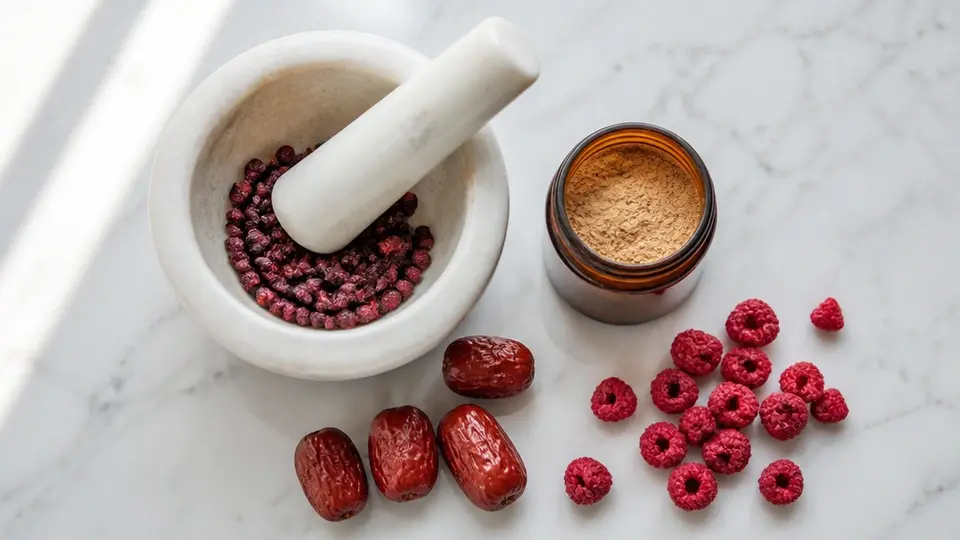
Schisandra is a woody vine native to parts of East Asia and Russia. Its red berries are known in traditional medicine as wu wei zi, often translated as "five-flavor berry" because the fruit is traditionally described as having several distinct tastes. That history explains why schisandra appears in many traditional preparations. It does not, by itself, establish that a modern tea will produce a specific medical effect.
Schisandra berry is one of six ingredients listed for Laicuherb 7 Days Bliss Tea. The other ingredients are raspberry fruit, stevia leaf, codonopsis root, astragalus root, and jujube seed [6]. The product is presented as a caffeine-free herbal tea for men, with individually portioned 8 g tea bags. The listed preparation is one tea bag in 240 ml of hot water at 80–100°C for 5–10 minutes.
Those preparation details are useful for consistency, but they do not tell us the concentration of every schisandra lignan in the finished cup. Water extraction, steeping time, raw-material variation, processing, and the ratio of ingredients can all influence what reaches the beverage.
What CYP Enzymes Mean in Plain English
Cytochrome P450, usually shortened to CYP, is a family of enzymes that helps the body process many medicines and other compounds. A medicine may be broken down more slowly when an enzyme is inhibited, or more quickly when an enzyme is induced. Either change can matter for some drugs, but the outcome depends on the medicine, dose, route of administration, therapeutic window, and the person taking it.
CYP3A4 is one of the most clinically important drug-metabolizing enzymes. It is involved in the metabolism of many medicines, including some immunosuppressants, cardiovascular drugs, cholesterol medicines, sedatives, and anti-anxiety medicines. That list is not a shortcut for deciding whether a particular drug is safe with schisandra. Two medicines in the same broad class can behave differently, and the same medicine can be affected by several pathways.
The frequently cited Iwata study examined schisandra fruit components in human liver microsomes, an in vitro laboratory system. It found potent inhibition of CYP3A4-related activity for some isolated constituents, while inhibition of CYP2C9, CYP2C19, and CYP2D6 was limited under the reported conditions [1]. A laboratory result tells us that a mechanism is plausible. It does not tell us that a brewed tea will reach the same concentration in a person, or that a patient will experience a measurable change in medication levels.
What Research Says — and Does Not Say — About Interactions
The research supports caution, not certainty.
In vitro studies
Studies using schisandra extracts or isolated lignans suggest that some constituents can inhibit or otherwise influence CYP3A-related activity [1][4]. The concentrations used may be far above those produced by a brewed beverage. The result is a mechanistic signal, not proof of harm from this tea.
Animal studies
Research on wu wei zi and related preparations has reported changes in drug-metabolism pathways, including findings involving warfarin in rats [3]. Animal findings identify a question for further study. They cannot establish the size, direction, or clinical importance of an interaction in people drinking 7 Days Bliss Tea.
Human case reports
A published case report examined deoxyschisandrin and blood tacrolimus levels [2]. Tacrolimus is a high-stakes medicine because its dosing is individualized and blood concentrations are routinely monitored. These reports are a strong reason for transplant patients and those taking narrow-therapeutic-index medicines to consult their specialist or pharmacist. They do not demonstrate that a single cup of this tea has the same effect as a concentrated preparation.
What has not been established is just as important. There is no product-specific clinical study showing that one cup of Laicuherb 7 Days Bliss Tea raises or lowers blood concentrations of a named medicine. There is no basis for promising that the tea is interaction-free, and there is also no basis for presenting a laboratory finding as proof that the tea will disrupt medication for most users.
Why Multi-Herb Blends Complicate Predictions
A six-herb blend creates a second layer of uncertainty. The schisandra evidence is the clearest interaction concern discussed in this article, but the finished beverage also contains astragalus, codonopsis, jujube seed, raspberry fruit, and stevia leaf. Studies of individual herbs, isolated compounds, or concentrated extracts cannot automatically predict what the finished blend will do.
The ingredients may differ in chemistry, dose, extraction into water, and quality from batch to batch. Unless the finished product has been studied as a complete formulation, it is not responsible to claim that the herbs work together in a clinically meaningful way. The honest position is simpler: more ingredients create more variables, so the pharmacist needs the actual label rather than the product name alone.
What Information to Bring to a Pharmacist
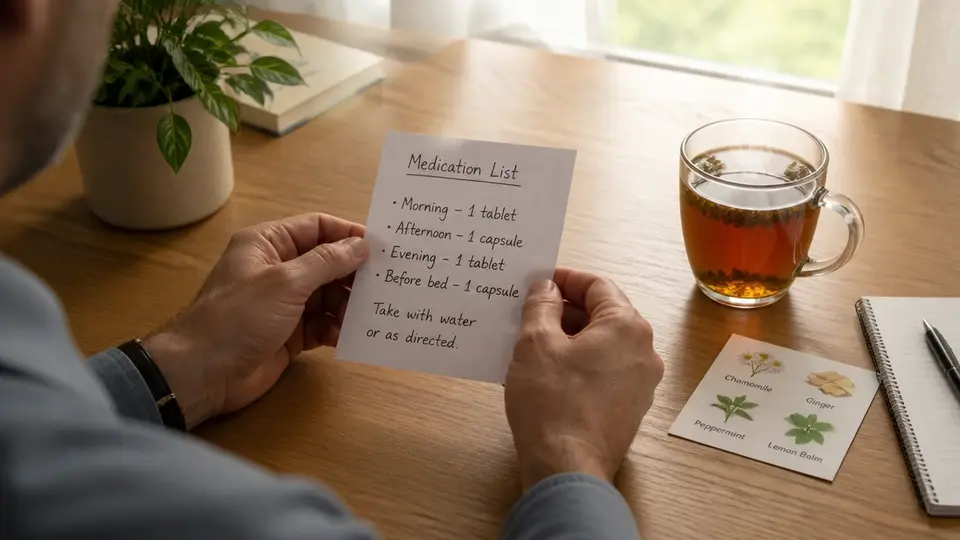
Bring a photo of the full product label or the product page, not just the word "schisandra." Include the complete ingredient list, the serving instructions, and the amount you plan to drink. For the current product information, that means six listed ingredients, one 8 g tea bag, 240 ml of hot water, and a 5–10 minute steeping time [6]. If you plan to drink it more often or prepare it differently, say so.
Bring the exact names and doses of every prescription medicine, over-the-counter medicine, vitamin, supplement, and other herbal product you take. Include medicines used only occasionally. A pharmacist may also ask about kidney or liver disease, pregnancy or breastfeeding, upcoming surgery, allergies, alcohol use, and whether your medicine requires blood tests.
Be especially direct if you take tacrolimus, cyclosporine, warfarin, seizure medicines, certain cancer medicines, or another medicine with a narrow therapeutic window. Do not assume that a food-grade label removes the need for an interaction review. At the same time, do not assume that a laboratory CYP result means you must stop a prescribed medicine or avoid every tea containing a trace botanical. The individual medication review is the part that cannot be replaced by a blog post.
When to Stop and Seek Advice
If you notice a concerning or unexpected reaction after drinking the tea, stop using it and contact a healthcare professional. Seek prompt medical help for severe symptoms such as fainting, trouble breathing, facial or throat swelling, chest pain, severe confusion, or signs of serious bleeding.
If you are scheduled for surgery or a procedure involving anesthesia, tell the surgical and anesthesia teams about every herbal tea and supplement you use. Official guidance warns that some supplements can affect bleeding risk, anesthesia response, or other medicines [5]. Follow the instructions from your surgical team.
If you have liver or kidney disease, ask your treating clinician before adding a new herbal product. Organ function, medication clearance, and the margin for error may already be different, while product-specific clinical data remain limited.
Conclusion
Schisandra has a plausible medication-interaction mechanism. Laboratory studies have reported effects on CYP3A4-related activity, animal research has raised questions about drug metabolism, and human reports involving concentrated schisandra-related preparations have made tacrolimus a particularly important example [1][2][3]. That is enough to justify a medication check. It is not enough to claim that one brewed cup of Laicuherb 7 Days Bliss Tea will cause a clinically important interaction.
The practical move is straightforward: keep the tea in the category it belongs to — a caffeine-free herbal beverage — and give your pharmacist the exact label, preparation, intended frequency, and complete medication list. A five-minute check is more useful than a sweeping promise of safety or a sweeping warning based on a test tube.
Explore Laicuherb’s 7 Days Bliss Tea
Laicuherb 7 Days Bliss Tea is listed as a caffeine-free men's herbal tea containing raspberry fruit, stevia leaf, schisandra berry, codonopsis root, astragalus root, and jujube seed. The product page lists 8 g per tea bag, 10 tea bags per box, and a preparation of one bag in 240 ml of hot water at 80–100°C for 5–10 minutes [6].
Those specifications help you show a pharmacist what you are considering. They do not establish a medical benefit or guarantee that the tea will not interact with medication. If you take prescription or over-the-counter medication, ask for an individualized interaction check before making this herbal tea part of your daily routine. For questions about the listed ingredients or product details, contact Laicuherb at hello@laicuherb.com.
Frequently Asked Questions
Can I drink 7 Days Bliss Tea if I take daily medications for blood pressure or cholesterol?
There is no reliable yes-or-no answer based only on the words "blood pressure" or "cholesterol" medication. Some medicines in these broad categories may involve CYP3A4 or other metabolic pathways, but individual medicines differ. Show the pharmacist the complete 7 Days Bliss Tea ingredient list and the exact name, dose, and formulation of your medicine before adding the tea to your routine. Do not change your medication without medical advice.
I have a liver condition. Is this tea safe for me?
The available schisandra evidence does not establish whether this specific brewed tea is safe for a person with a particular liver condition. Liver disease can affect how medicines and other compounds are processed, so ask the clinician who manages your condition or a pharmacist who can review your medication list. The product should be treated as a food-grade herbal beverage, not as a way to support or manage liver function.
Should I stop drinking this tea before surgery?
Tell your surgeon and anesthesia team that you use the tea and provide the ingredient list. They will decide whether and when to pause it based on the procedure, your medicines, and your health history. Do not stop prescription medicines unless the medical team specifically instructs you to do so.
References
[1] Iwata H et al. (2004). Identification and characterization of human CYP2C9 and CYP3A4 inhibitory components in Schisandra chinensis. Drug Metabolism and Pharmacokinetics. PubMed 15342469
[2] Jiang W et al. (2010). The effect of deoxyschisandrin on blood tacrolimus levels: A case report. Immunopharmacology and Immunotoxicology. doi:10.3109/08923970903117365
[3] Mu Y et al. (2006). Traditional Chinese medicines Wu Wei Zi and Gan Cao activate pregnane X receptor and increase warfarin clearance in rats. J Pharmacol Exp Ther. PubMed 16267138
[4] Zhang F et al. (2022). A comprehensive review of the main lignan components of Schisandra chinensis and Schisandra sphenanthera. Frontiers in Pharmacology. PMC8962666
[5] National Center for Complementary and Integrative Health. Using Dietary Supplements Wisely. NCCIH
[6] Laicuherb. 7 Days Bliss Tea. laicuherb.com