Himalayan Sea Buckthorn Oil: How to Read a COA Before Buying






This article reflects general health science and consumer supplement literacy. It does not replace professional medical advice.
Table of Contents
→ Quick Answer: A COA Verifies a Batch, Not Every Marketing Claim
→ Confirming Product Identity and Batch Number
→ Reading the Fatty-Acid Profile
→ Oxidation and Freshness Indicators
→ Heavy Metals, Pesticides, and Microbial Results
Quick Answer: A COA Verifies a Batch, Not Every Marketing Claim
A Certificate of Analysis records what was measured on one lot, with which method, and whether those results sat inside the specification written on that report.
It does not prove every line on the sales page. It does not predict how the oil will feel in your body. It does not guarantee the next lot will look identical.
On a Himalayan sea buckthorn oil COA you should see product name, lot or batch number, test names, methods, numbers, and a spec or pass/fail for each test. You will not see a clinical trial. You will not see a health outcome. Paperwork for one batch is not evidence of effect.
Confirming Product Identity and Batch Number
Start at the header. The product name should match the label closely enough that you are not looking at a generic "berry oil." The lot number on the COA must match the lot on the bottle or carton you receive. If those two numbers differ, stop. That file is about someone else's oil.
Also look for manufacture date and test date. An undated sheet is incomplete.
Laicuherb's oil is listed as whole berry: seed plus pulp, with omega-3, omega-6, omega-7, and omega-9 on the Supplement Facts panel [5]. The COA should name Hippophae rhamnoides and state whole fruit, seed, or pulp. “Berry oil” with no plant part is a question for the seller before you pay.
| COA section | What to match | Walk away if |
|---|---|---|
| Product name | Same product as the label | Vague or generic name |
| Batch / lot number | Same as your bottle | Missing or different |
| Source material | Whole berry, seed, or pulp stated | No plant part named |
| Dates | Manufacture and test dates present | Undated |
Reading the Fatty-Acid Profile
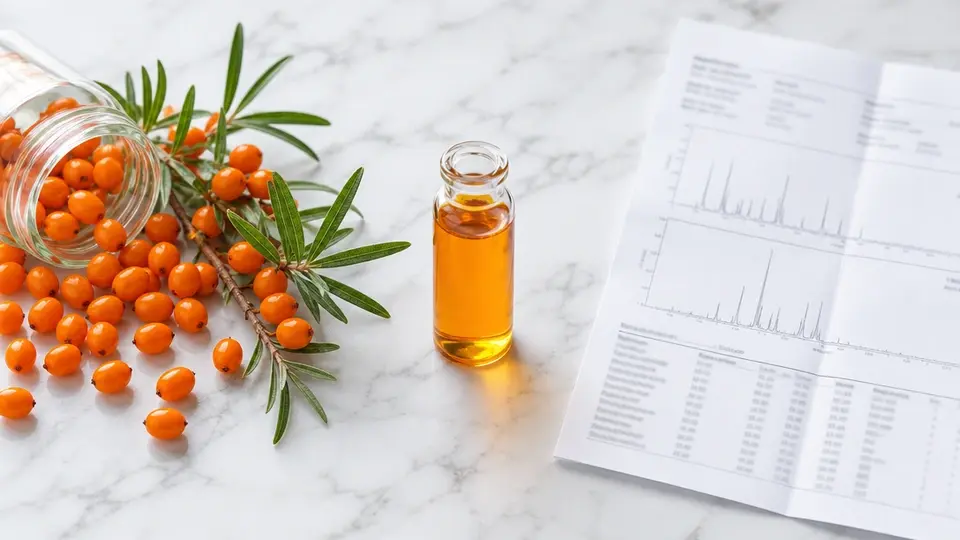
For sea buckthorn, this is the section that tells you what kind of oil you bought.
Seed oil is rich in linoleic acid (omega-6) and alpha-linolenic acid (omega-3). Pulp/soft-part oil is rich in palmitic and palmitoleic acids; palmitoleic acid is omega-7 [2][4]. Whole-berry oil should show both patterns: omega-3, omega-6, omega-7, and omega-9 in one panel [1][2][3].
Percentages move with origin, altitude, harvest, and extraction [2]. Presence of all four families is the fingerprint of a whole-fruit oil. A seed-only oil will not look like a pulp oil. Do not treat “omega-7” on the front label as proof if the COA fatty-acid table is missing palmitoleic acid.
Laicuherb states low-temperature supercritical CO2 extraction [5]. A COA cannot photograph the extractor. It can show whether the fatty-acid mix looks like whole berry rather than a seed-oil blend.
GC (gas chromatography) is the standard method for fatty-acid profiling. If the method line is blank, ask before you buy.
Oxidation and Freshness Indicators
Oil oxidizes. A COA should include at least one freshness marker, most often peroxide value (PV). Some labs also report p-anisidine value (AV). PV tracks early oxidation. AV tracks later breakdown after heat, air, or age.
Read the number against the specification on that same sheet. There is no single “good” PV that applies to every edible oil and every lab method. A missing oxidation line is a gap, not a pass.
CO2 extraction runs with little oxygen and without high solvent heat, which is why brands use it for fragile oils. That process claim is not the same as a low PV on your lot. Only the oxidation result on this batch answers freshness at the time of testing.
Freshness data does not describe a health benefit. It describes whether the oil still looked stable when it was tested.
Safety is the next layer: what the oil was checked for, and what was not. Product specification or sourcing questions: hello@laicuherb.com.
Heavy Metals, Pesticides, and Microbial Results
For an oil you swallow, look for a heavy-metal panel — typically lead, arsenic, cadmium, and mercury — each with a unit (ppm, ppb, or µg/g), a result, and a specification. ICP-MS is the common method.
Do not memorize a blog's “typical limit” table. Limits depend on the standard the lab cited (USP, EU, in-house). Compare result to the spec on that COA. If there is a number and no spec, ask which standard they used.
Wild high-altitude fruit is not automatically pesticide-free on paper. A complete COA still reports a pesticide screen. Organic certification sets residue rules for the operation. The COA gives the measured numbers for that lot [5][6].
Microbiology, when present, usually includes total plate count, yeast and mold, and named pathogens such as Salmonella and E. coli, each against a limit. Oil is a low-water matrix; some labs still run the panel. “Not tested” should be written, not implied.
Laicuherb lists Non-GMO and USDA Organic on the product page [5]. Those marks are not a substitute for the figures on your lot. If a safety line is missing, ask before you buy.
| Safety test | What the line is for | How to read it |
|---|---|---|
| Lead, arsenic, cadmium, mercury | Elemental contaminants | Result vs spec on this COA; method named |
| Pesticide residues | Agricultural chemicals | Screened, with limit or "not detected" |
| Total plate count / yeast and mold | General microbes | Result vs stated limit |
| Salmonella / E. coli | Named pathogens | Absent / pass against the spec |
Laboratory Identity, Methods, and Dates
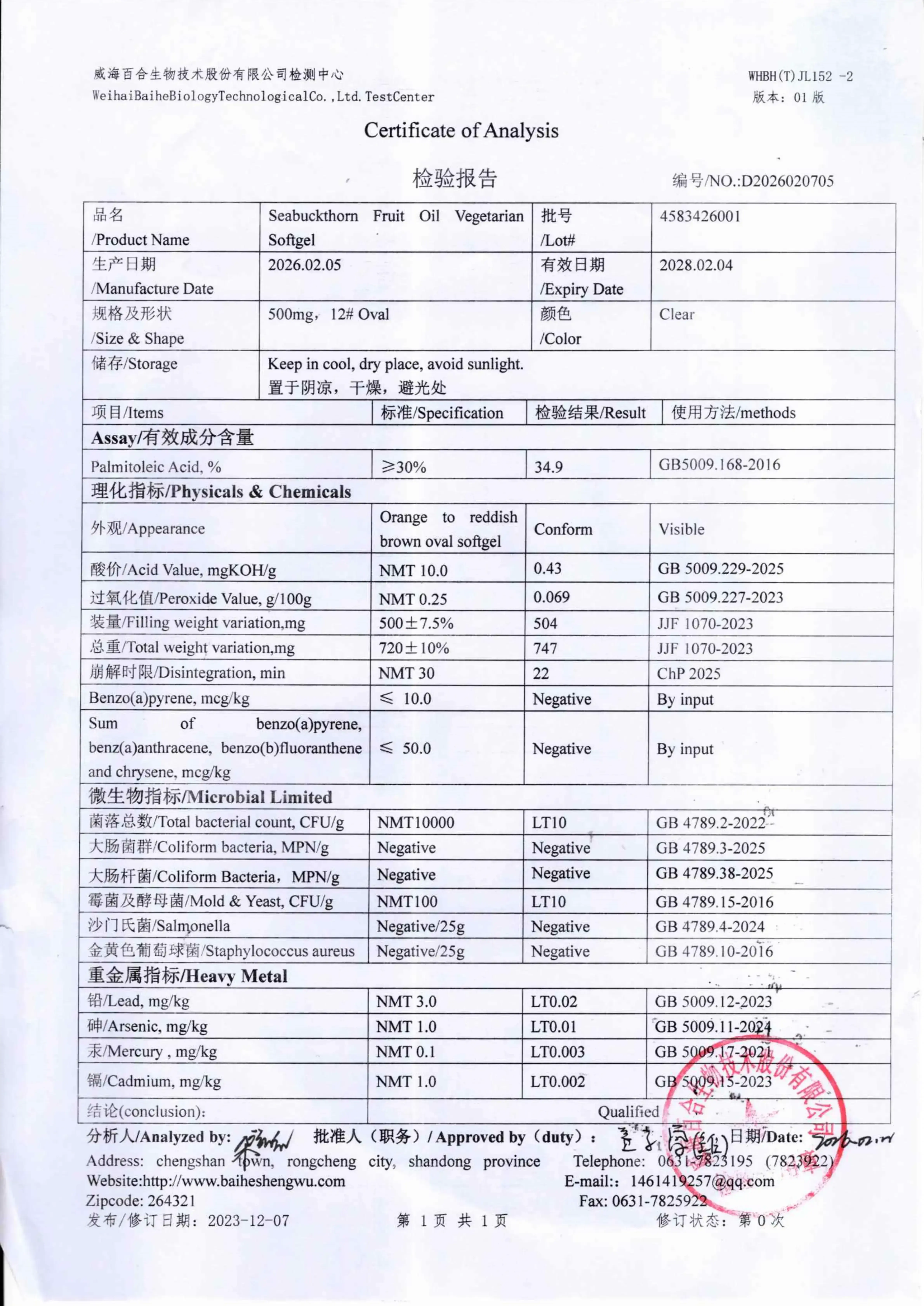
Who tested it matters as much as the numbers.
The sheet should name the lab, show a way to identify it (accreditation, address, or report ID), and name the method per test. Fatty acids: GC. Metals: ICP-MS. Microbes: a stated plate-count or pathogen method.
“Internal method” or “proprietary” with no further detail leaves you unable to check the method against a published standard. Ask for the method ID.
The test date is not decoration. A COA from a year ago describes oil that has since sat in storage. For sea buckthorn oil, oxidation continues after filling. A recent test date is more useful than an old one, and still only describes the day it was run.
Facility certificates (NSF cGMP, BRC) describe the plant's quality system [5][6]. They are not the batch COA. Keep those files in different folders in your head.
View all the certificates of Himalayan Sea Buckthorn Oil
What a COA Does Not Prove
A COA does not prove the oil will moisturize skin, change immunity, or help the heart. Those claims, when they appear in marketing, sit outside this document. One lab sheet cannot replace a controlled human trial.
It also cannot, by itself, prove “Himalayan.” Botanical ID as Hippophae rhamnoides plus a fatty-acid fingerprint can support sea buckthorn. Regional origin usually needs harvest or supply-chain records on top of the COA.
Absorption and “what it will do for you” are not COA fields.
What it does prove, if the lot matches: those tests were run on that batch, and those results were inside or outside the stated limits on the test date. A snapshot. Not a promise.
Conclusion
COA Reading Checklist
- Lot number on COA matches the bottle
- Fatty acids show all four omega families (whole-berry fingerprint)
- Oxidation marker (PV at minimum) is reported with a spec
- Heavy metals, pesticide screen, and microbial results present
- Lab name, method per test, and test date all named
Read a Himalayan sea buckthorn oil COA in one pass: lot matches the bottle, fatty acids look like whole berry (all four omega families), oxidation is reported, metals/pesticides/microbes have results and specs, and the lab, methods, and dates are named.
That file verifies one batch. It does not verify health outcomes.
Laicuherb's public quality page holds general COA and organic/facility certificates [6]. For the lot you will drink, request the matching COA, put it next to the bottle, and read the lines above.
FAQ
Q1: What if the COA is missing a test I expected to see?
Pause. For this oil, a usable sheet usually includes identity, fatty acids, at least one oxidation marker, heavy metals, a pesticide screen, and microbe results if the brand runs them. A seller who cannot fill the gap or explain it is not ready to take the order.
Q2: How do I know if a result is pass or fail if the COA only shows numbers?
A complete report pairs each result with a specification. If you only have a raw number, ask which standard they used. Do not borrow a limit from a blog table.
Q3: Can a COA confirm that my Himalayan sea buckthorn oil is authentic Himalayan-sourced?
It can support botanical identity and a fatty-acid pattern typical of sea buckthorn. "Himalayan-sourced" usually needs traceability or origin documents as well. If origin is the reason you are buying, ask for those files with the COA.
Shop Lab-Verified Himalayan Sea Buckthorn Oil from Laicuherb
Laicuherb Himalayan Sea Buckthorn Oil – Whole Berry Extract is USDA Organic whole-fruit oil, vegan, Non-GMO, extracted by supercritical CO2, produced in NSF cGMP and BRC facilities [5][6]. Current serving on the product page: 2 softgels, 15 servings, 1000 mg oil, 324 mg omega-7 [5].
Quality & Certifications
USDA Organic | NSF cGMP | BRCGS | Non-GMO | Vegan | CO2 Extracted
This is a dietary supplement. A COA does not diagnose, treat, cure, or prevent disease.
Batch COA, certificates, and sourcing questions: cardiovascular/himalayan-sea-buckthorn-oil">Himalayan Sea Buckthorn Oil product page and hello@laicuherb.com. Match the lot number before you decide.
References
[1] Zielíska, A., & Nowak, I. (2017). Abundance of active ingredients in sea-buckthorn oil. Lipids in Health and Disease, 16, 95. https://pubmed.ncbi.nlm.nih.gov/28526097/
[2] Yang, B., & Kallio, H. P. (2001). Fatty acid composition of lipids in sea buckthorn (Hippophaë rhamnoides L.) berries of different origins. Journal of Agricultural and Food Chemistry, 49(4), 1939–1947. https://pubmed.ncbi.nlm.nih.gov/11308350/
[3] Beveridge, T., Li, T. S. C., Oomah, B. D., & Smith, A. (1999). Sea buckthorn products: Manufacture and composition. Journal of Agricultural and Food Chemistry, 47(9), 3480–3488. https://pubmed.ncbi.nlm.nih.gov/10552681/
[4] Yang, B., & Kallio, H. (2002). Composition and physiological effects of sea buckthorn (Hippophaë) lipids. Trends in Food Science & Technology, 13(5), 160–167. https://doi.org/10.1016/S0924-2244(02)00045-9
[5] Laicuherb. Himalayan Sea Buckthorn Oil. https://www.laicuherb.com/cardiovascular/himalayan-sea-buckthorn-oil
[6] Laicuherb. Quality Certifications. https://www.laicuherb.com/quality-certifications
Related Readings
Omega-7 Supplement Dosage: No RDA, Study Ranges, and Label Use
Feminine Moisture Supplement Research: How to Read Study Timelines
Skin Glow Supplement with Collagen: Can You Take Both?
|
SJ
|
Dr. Sarah Jenkins Women's Health & Botanical Nutrition Specialist Reviewed for botanical sourcing accuracy and supplement literacy. Content reflects general health science literature and does not constitute medical advice. |