How Long Does It Take for Cycle Tea to Work? A Realistic Timeline






Table of Contents
Quick Answer: Most Users Notice Changes Over 2–3 Full Cycles →
Why Herbal Support Is Cumulative, Not Immediate →
Month 1: What to Realistically Expect →
Month 2–3: Tracking Meaningful Changes →
Factors That Affect How Quickly You Notice Results →
How to Track Your Own Progress →
People ask this because they have been sold overnight results. A Cycle Tea Set is not that kind of product.
Laicuherb’s Cycle Tea Set is four brew-only herbal teas matched to four use windows: Ease Period Comfort Tea during menstruation (8 g × 7), Pure Energy & Refreshing Tea in the follicular phase (3 g × 7, contains green tea and therefore caffeine), Bloom Hormone Balance Tea around ovulation (8 g × 7), and Rest Calm & Sleep Tea in the luteal phase (8 g × 10). That is 31 sachets, mapped to the set’s 31 Record Calendar stickers one-to-one [7]. The teas are food-grade beverages. They are not intended to diagnose, treat, cure, or prevent any disease [7].
A realistic timeline is about how long you need to watch a monthly ritual, not how long it takes herbs to “correct” a cycle. Cycles themselves already take weeks to repeat, and length varies from person to person [1]. None of that is a clinical onset curve for this set.
Quick Answer: Most Users Notice Changes Over 2–3 Full Cycles
There is no published trial of this finished Cycle Tea Set that measures “time to work.” So “2–3 cycles” should not be read as a typical results date.
What 2–3 cycles are useful for is comparison. One period is a noisy sample. Sleep, stress, travel, caffeine, and pain all move on their own [1][2]. If you want to know whether a phase-matched tea ritual is worth keeping, you need more than one pass through menstruation, follicular days, ovulation timing (if you can see it), and luteal days.
What you can notice the same day is narrower: warmth and flavor in the cup, a pause in the afternoon, or the caffeine in Pure if you drink it late. That is beverage experience. It is not proof the blend changed hormones, shortened cramps, improved sleep architecture, or made the next period easier.
If you still have a cycle, drink the tea that matches the phase you can actually observe. If the phase is unclear, do not invent Day 14. Keep notes. Reassess after two or three cycles, or sooner if symptoms are severe.
Why Herbal Support Is Cumulative, Not Immediate
Ibuprofen has a known mechanism and a known window for period pain [5]. Cycle tea does not.
Calling herbal support “cumulative” is often marketing for “wait longer.” For this set, there is no dose-finding study showing ginger, longan, ashwagandha, or green tea from these sachets building up to a therapeutic level in your tissues. Ease is a warming menstrual drink, not a prostaglandin blocker [5][7]. Rest includes ashwagandha as one herb in an infusion; extract trials at hundreds of milligrams per day do not transfer to one bag of tea. Pure’s caffeine can act the same day because caffeine is a stimulant, not because the follicular blend “accumulates vigor.”
What does add up is habit. You learn which box to open. You stop treating every week as the same mug. You see whether the ritual is pleasant enough to repeat. That is cumulative in the calendar sense. It is not botanical therapy slowly rewriting the menstrual cycle [1].
Month 1: What to Realistically Expect
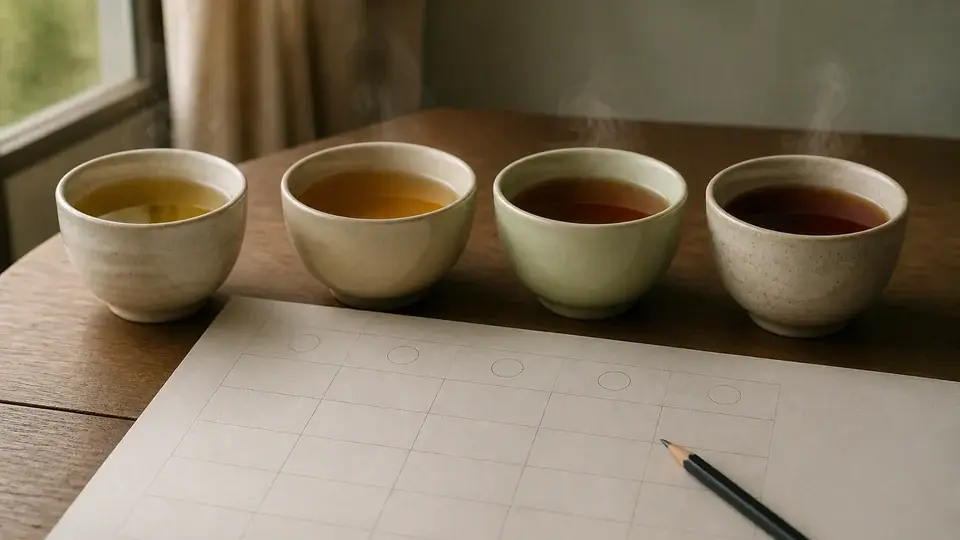
Month 1 is logistics.
You find out whether you can tell menstrual days from the rest of the month. You find out that Pure has caffeine and may not belong at 9 p.m. You find out that Bloom’s product name says “hormone balance” while the honest use is an ovulation-window beverage, not a lab result. You find out Rest is an evening luteal cup, not a sleeping pill.
The 31 Record Calendar is a sticker map of the 31 bags in the box, not a medical cycle. If your period lasts four days, you do not owe the calendar seven Ease stickers. If you do not detect ovulation, skip guessing Bloom by date.
Comfort from a hot drink can show up on day one. A “new cycle personality” will not. If pain is already severe in month 1, that is a clinical question, not a sign you have not waited long enough.
Month 2–3: Tracking Meaningful Changes
By the second and third cycles you have a before-and-after of your notes, not a before-and-after of a trial.
Look for pattern, not miracle. Did Ease stay a cup you wanted on bleeding days? Did Pure stay a morning drink because of caffeine? Did Rest remain an evening cue? Did anything get worse?
“More intuitive PMS” and “cherished warmth” are feelings. Write them down if they matter to you. Do not upgrade them into evidence that the set treated premenstrual symptoms. There is no finished-blend RCT here to support that leap [3][5].
If you want brew or phase-box questions, hello@laicuherb.com. If you want interpretation of pain, bleeding, fertility, or sleep collapse, that is a clinician.
Factors That Affect How Quickly You Notice Results
What you notice, and when, depends less on a universal herbal clock than on confounders.
Cycle length is not fixed at 28 days [1]. Sleep quality already shifts across the menstrual cycle in research that has nothing to do with tea [2]. Diet, alcohol, training, travel, and stress move the same outcomes people hope a tea will move.
Consistency matters for the ritual: the wrong tea in the wrong week is just a random bag. Caffeine sensitivity matters for Pure. Expectations matter: if you are waiting for the set to replace pain medicine, you will call it a failure even if the cup was pleasant [5][7].
None of these factors convert the set into a timed treatment.
How to Track Your Own Progress
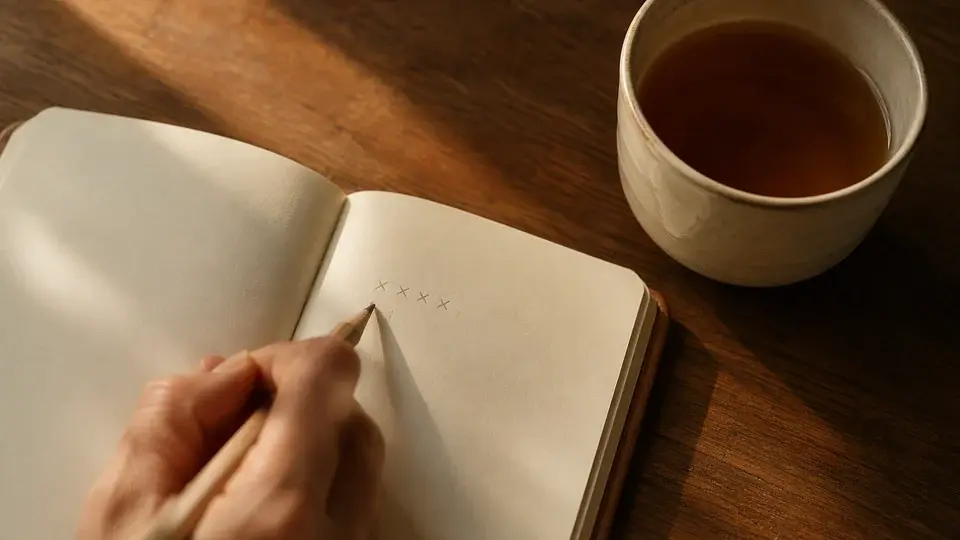
Keep it small. Two or three items, not a wellness novel.
Before you start, write a one-week baseline: bleeding days, pain 0–10 if pain is why you bought Ease, sleep timing if Rest is the point, and afternoon energy if Pure is the point. Then log the tea you actually drank, not the phase you wish you were in.
Review at the end of each cycle. Compare to the baseline, not to a blog’s 2–3 cycle promise.
A calendar sticker that matches the bag you opened is useful. A made-up date list is not.
Tracking is for your decision to continue, switch, or stop. It is not a clinical trial of Laicuherb [3].
When to Reassess (or See a Doctor)
Reassess the routine after two or three cycles if you are otherwise stable and still curious. Reassess the body immediately if something is wrong.
See a clinician for severe pelvic pain, soaking through protection hourly, bleeding after sex, no periods, suddenly chaotic cycles, pregnancy, breastfeeding, new medicines, or symptoms that look like endometriosis, anemia, thyroid trouble, or depression. Cycle tea is not the next step in that list [4][5].
If three months of pleasant tea changed nothing you cared about, do not add a fifth blend. Flat notes mean the ritual did not earn a bigger stack.
Conclusion
Cycle tea “working” is the wrong frame if you mean medical onset.
A warm, phase-matched cup can be useful the day you brew it. Judging whether the four-box ritual belongs in your month takes more than one cycle because months are the unit the cycle already uses [1]. That is a tracking window. It is not a guarantee that most people feel different at cycle three.
Laicuherb’s set is Ease, Pure, Bloom, and Rest as brew-only drinks with a 31-bag calendar map [7]. Keep hormones, fertility, PMS, and disease off the timeline. Individual experience varies. Severe or persistent symptoms need a doctor, not a longer steep.
FAQ
Q: How should the teas in the Cycle Tea Set be used?
A: Brew and drink them. Ease during menstruation, Pure in the follicular phase (contains caffeine), Bloom around ovulation if you have a reason to think you are in that window, Rest in the luteal phase. You can start on any day with the tea that matches the phase you can observe. They are not for cooking or skin.
Q: Can these health-care teas be used for cooking or applied topically?
A: No. They are intended only for brewing and drinking as a beverage.
Q: Do these herbal teas cure menstrual disorders or replace medical treatment?
A: No. They are not intended to diagnose, treat, cure, or prevent any disease. They do not replace pain medicine, hormone therapy, or gynecologic care.
Experience Phase-Aligned Care with Laicuherb
If you want a four-cup map for weeks you can already tell apart, the Cycle Tea Set is Ease × 7, Pure × 7, Bloom × 7, and Rest × 10. Follow the label. Use the 31 Record Calendar as a bag tracker, not a diagnosis.
For ingredients, brew, or which box is which, write hello@laicuherb.com. For pain, bleeding, fertility, pregnancy, or medicines, speak with a healthcare professional.
Cycle Tea Set: https://www.laicuherb.com/cycle-harmony/cycle-tea-set
References
[1] Reed, B. G., & Carr, B. R. (2018). The normal menstrual cycle and the control of ovulation. In K. R. Feingold et al. (Eds.), Endotext. MDText.com. https://www.ncbi.nlm.nih.gov/books/NBK279054/
[2] Baker, F. C., & Driver, H. S. (2007). Circadian rhythms, sleep, and the menstrual cycle. Sleep Medicine, 8(6), 613–622. https://pubmed.ncbi.nlm.nih.gov/17420154/
[3] Ernst, E. (2000). Herbal medicines: where is the evidence? Journal of Family Practice, 49(10), 877–879. https://pubmed.ncbi.nlm.nih.gov/11052158/
[4] Harlow, S. D., & Campbell, O. M. R. (2004). Epidemiology of menstrual disorders in developing countries: a systematic review. BJOG, 111(1), 6–16. https://pubmed.ncbi.nlm.nih.gov/14687045/
[5] Marjoribanks, J., Ayeleke, R. O., Farquhar, C., & Proctor, M. (2015). Nonsteroidal anti-inflammatory drugs for dysmenorrhoea. Cochrane Database of Systematic Reviews, 2015(7), CD001751. https://www.cochrane.org/evidence/CD001751_nonsteroidal-anti-inflammatory-drugs-dysmenorrhoea
[6] National Center for Complementary and Integrative Health. Using Dietary Supplements Wisely. https://www.nccih.nih.gov/health/using-dietary-supplements-wisely
[7] Laicuherb. Cycle Tea Set. https://www.laicuherb.com/cycle-harmony/cycle-tea-set
Related Readings
Cycle Tea Set: The Phase-by-Phase Recommendation
From Flow to Rest: A Functional Cycle Tea Set Approach
How to Improve Your Health and Energy Every Day of the Month