How to Read a Supplement Label: A Buyer's Guide for Herbal Teas and Softgels






Table of Contents
- Quick Answer: Check Serving Size, Active Ingredients, Certifications, and Third-Party Testing →
- Understanding the Supplement Facts Panel →
- What Certifications Actually Mean (NSF / USDA Organic / BRCGS / cGMP) →
- Red Flags to Watch For →
- How to Apply This to Laicuherb Products →
- Conclusion →
- FAQ →
- Shop with Confidence Using Laicuherb Standards →
The front of the box is the pitch. The back is the contract.
You do not need a chemistry degree to read that contract. You need to know which panel you are looking at. A herbal tea sold as a drink and a vegan softgel sold as a dietary supplement do not share one FDA template. Hunt for a Supplement Facts box on a conventional tea and you will think the brand is hiding something when the law never asked for that box in the first place.
Laicuherb sells both: cycle teas meant for hot-water brewing, and Himalayan Sea Buckthorn Oil as an oral softgel. The reading habit is the same. The legal category is not.
Quick Answer: Check Serving Size, Active Ingredients, Certifications, and Third-Party Testing
Thirty seconds is enough if you know the order.
Serving size first — not the capsule count on the lid. cardiovascular/himalayan-sea-buckthorn-oil">Himalayan Sea Buckthorn Oil is 2 vegan softgels per serving and 15 servings in a 30-softgel bottle, which is 1000 mg oil, not “one pill equals one serving” [7]. Rest Calm and Sleep Tea is 8 g per bag, 10 bags, 80 g net [8]. Two products, two math problems.
Then the contents of that serving. For a supplement, that is the Supplement Facts list. For a tea sold as a beverage, that is the ingredient list, with plant part when the brand bothers to print it (nettle leaf, raspberry fruit). “Ashwagandha” with no plant part is still a name, just a thinner one.
Then the seals. cGMP under 21 CFR Part 111 is the FDA manufacturing rule for dietary supplements, not a medal the company invented [3]. NSF cGMP and BRCGS/BRC, as used on Laicuherb’s oil page, describe the facility. USDA Organic is a USDA National Organic Program claim: “Organic” means at least 95 percent organic ingredients, not counting salt and water [6]. A facility seal is not a batch test.
Then third-party testing. That is a certificate of analysis for a lot — identity, contaminants, sometimes fatty acids — not the logo on the carton. Ask for the batch that matches the bottle.
In the United States, dietary supplements sit under the Dietary Supplement Health and Education Act of 1994 (DSHEA). FDA does not approve these products before they are sold. The firm is responsible for making sure the product is not adulterated or misbranded, and that claims are substantiated so they are not false or misleading [1][4]. A product labeled as a dietary supplement still cannot be sold to treat, cure, or prevent a disease. That claim turns it into a drug in FDA’s reading [4].
A tea represented as a conventional food follows food labeling. A softgel labeled as a dietary supplement follows 21 CFR 101.36. Read the panel that actually applies.
Understanding the Supplement Facts Panel
What is a Supplement Facts panel? It is the nutrition box required on most U.S. dietary supplements under 21 CFR 101.36. It is not the Nutrition Facts panel on ordinary food [2].
The panel states serving size, servings per container, and the amount of each dietary ingredient in that serving. Serving size is the manufacturer’s choice. FDA does not standardize it and does not cap how much of an ingredient can sit in one serving, beyond the usual safety and labeling duties [4]. That is why “30 capsules” on the front can be 15 servings on the back. Always divide.
When the ingredient is a plant, a useful label names the plant part — root, leaf, fruit, seed — not only the grocery name. Standardized extracts, when they are standardized, name the marker (for example, withanolides). Whole-herb teas and whole-berry oils often are not standardized. That is a formulation choice, not a defect. It does mean you cannot treat “ashwagandha” on a tea bag as if it were a clinical extract dose.
Proprietary blends are legal. FDA requires the total weight of the blend and the names of the dietary ingredients, generally in descending order by weight. It does not require the milligrams of each herb inside the blend [2][4]. You can still buy the product. You cannot compare it gram-for-gram with a fully quantified formula.
“Other Ingredients” is the rest of the recipe: capsule shells, glycerin, water, flavors. Himalayan Sea Buckthorn Oil lists a vegan shell of tapioca starch, vegetable glycerin, and purified water [7]. If that line is missing on a supplement, you are missing the non-dietary part of what you swallow.
A tea sold only as a brew may never carry Supplement Facts. Judge it on net weight, bag weight, the full ingredient list, brewing directions, and whatever certificates that SKU actually holds.
What Certifications Actually Mean (NSF / USDA Organic / BRCGS / cGMP)
cGMP, in this context, is 21 CFR Part 111: the FDA rule for manufacturing, packing, labeling, or holding dietary supplements. It is about identity, purity, quality, strength, composition, records, and sanitation [3]. Every U.S. supplement facility is supposed to follow it. Printing “cGMP” on a carton does not, by itself, prove an independent auditor walked the floor.
NSF is a third-party organization. “NSF cGMP” on a product page usually means the plant has an NSF GMP registration or related facility audit. That is not the same as an NSF mark on the finished bottle that the product itself was certified to a dietary-supplement standard, and it is not NSF Certified for Sport. Check the public listing if the distinction matters to you. Laicuherb’s oil is described as produced in NSF cGMP and BRC certified facilities [7]. Rest Tea’s listed certificates are ISO-FSSC, HACCP, HALAL, COI, and COA — a different stack [8]. Do not copy the oil’s seals onto the tea.
USDA Organic is USDA’s program, not FDA’s. “Organic” on the package requires at least 95 percent organic ingredients, excluding salt and water, and a USDA-accredited certifier [6]. “100 percent organic” is a stricter category. “Made with organic…” is 70 percent and may not use the USDA seal. Himalayan Sea Buckthorn Oil is labeled USDA Organic [7]. That is an agricultural-production claim. It is not a clinical result.
BRCGS (formerly BRC) is a widely used food-safety scheme for manufacturing sites. It speaks to how the plant is run. It does not reprint the milligrams on your label.
None of these seals replace a batch COA. A responsible brand will still show testing for the lot in your hand: identity, contaminants, and — for an oil — the fatty-acid panel that matches the Supplement Facts. Facility certification plus batch data is the pair. Either one alone is a partial story.
Red Flags to Watch For
A proprietary blend is not automatically unsafe. It is automatically less comparable. If the only number is a combined gram weight, you cannot tell whether the expensive herb is a dusting.
“Treat,” “cure,” or “prevent” a disease on a supplement or tea is not a strong sales line. Under U.S. law it is a drug claim [4]. Overnight transformation, dramatic weight loss, and guaranteed hormone results sit in the same neighborhood. Walk past them.
No lot number, no expiration or best-by date, no manufacturer or distributor name and place of business — that is not minimalism. Dietary supplement labels also need a domestic address or phone for serious adverse event reporting [4]. Missing contact is a practical problem before it is a philosophical one.
Origin and testing secrecy is the quiet version of the same issue. You are allowed to ask where the herb was grown or which lab ran the heavy metals. A company that will not answer is telling you how it likes to be shopped. For Laicuherb specs, hello@laicuherb.com is the published channel [7][8].
How to Apply This to Laicuherb Products
Run the same four checks on the actual pages. Do not assume every SKU inherited every seal.
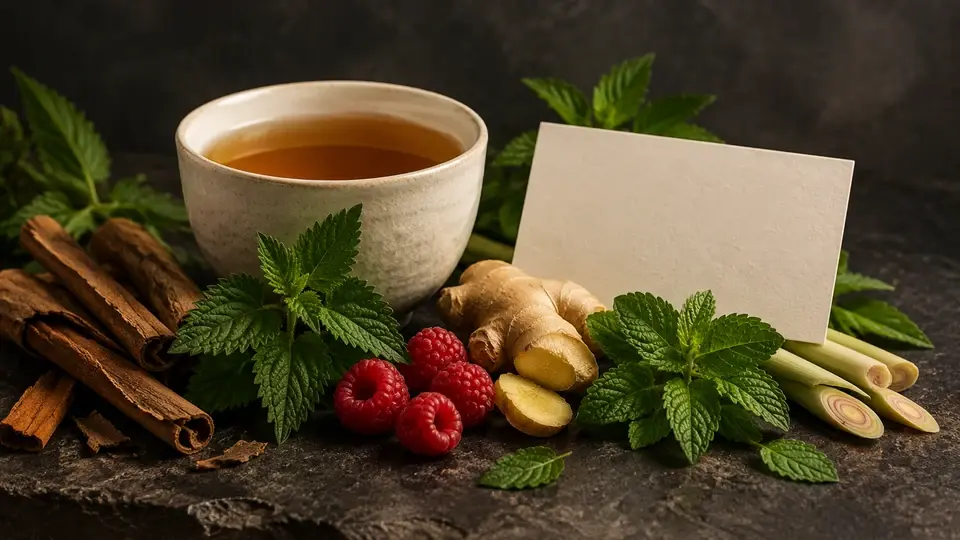
Rest Calm and Sleep Tea lists cinnamon, nettle leaf, raspberry fruit, ginger, spearmint, lemongrass, ashwagandha, and radix asparagi. The pack is 8 g × 10 bags (80 g / 2.82 oz). The certificates named on that page are ISO-FSSC, HACCP, HALAL, COI, and COA [8]. It is a luteal-phase evening beverage. It is not a sleep drug, a PMS treatment, or a hormone product. Use: hot-water brewing and drinking only. Not for cooking or skin.
Himalayan Sea Buckthorn Oil is the supplement in this pair. Supplement Facts: serving size 2 vegan softgels, 15 servings, 1000 mg organic sea buckthorn oil, with the labeled omega split (including 324 mg palmitoleic acid) plus the small vitamin A and E lines [7]. Facility language: NSF cGMP and BRC. Product claims on the page include USDA Organic, Non-GMO, and Vegan. Oral softgel only. Not a topical oil and not a cooking oil.
That is the combination worth copying when you shop anyone else: a serving you can calculate, ingredients you can name, seals that belong to that SKU, and a way to ask for the test that matches the lot.
Conclusion
Reading a label is not a personality trait. It is arithmetic plus category.
Serving size, named ingredients with plant parts when given, seals that mean what they say, and batch testing you can request. Proprietary blends, disease-cure copy, and a missing lot line are reasons to put the jar back. Laicuherb’s teas are drinks. The sea buckthorn SKU is a labeled dietary supplement. Keep those jobs separate and the back of the pack starts to make sense.
FAQ
What should I look for first on an herbal tea supplement label?
Confirm whether you are holding a conventional tea or a product labeled as a dietary supplement. For Rest Tea, start with bag weight (8 g), bag count (10), the full ingredient list with plant parts where printed, brewing use only, and the certificates on that page [8]. If the item is truly a supplement, start with serving size and the Supplement Facts panel instead. 2.
Does a "proprietary blend" label mean a product is unsafe?
Not necessarily. It means you cannot see each herb’s milligrams, which makes a fair comparison harder [2][4]. 3.
Can I use Laicuherb teas for cooking or topical application?
No. Laicuherb teas are for hot-water brewing and drinking only, not for cooking, topical use, or any other purpose [8].
Shop with Confidence Using Laicuherb Standards
A usable label is one you can audit in under a minute. Rest Tea publishes bag weight, a named herb list, and the certificates attached to that tea. Himalayan Sea Buckthorn Oil publishes 2-softgel servings, 15 servings per bottle, 1000 mg oil, Other Ingredients, and the facility and organic claims attached to that oil [7][8]. Teas stay in the cup. Softgels stay oral, as the label states.
Questions on a spec, a seal, or a batch test: hello@laicuherb.com.
Apply the same reading habit across the range → https://www.laicuherb.com/
References
[1] Dietary Supplement Health and Education Act of 1994, Pub. L. No. 103-417, 108 Stat. 4325.Dietary Supplement Health and Education Act of 1994 — Congress.gov record
[2] U.S. Food and Drug Administration. Dietary Supplement Labeling Guide, Chapter IV. Nutrition Labeling.FDA Dietary Supplement Labeling Guide — Chapter IV: Nutrition Labeling
[3] Current Good Manufacturing Practice in Manufacturing, Packaging, Labeling, or Holding Operations for Dietary Supplements, 21 C.F.R. Part 111.21 CFR Part 111 — Dietary Supplement Current Good Manufacturing Practice
[4] U.S. Food and Drug Administration. Questions and Answers on Dietary Supplements.FDA Questions and Answers on Dietary Supplements
[5] Nutrition Labeling of Dietary Supplements, 21 C.F.R. § 101.36.21 CFR 101.36 — Nutrition Labeling of Dietary Supplements
[6] U.S. Department of Agriculture, Agricultural Marketing Service. Labeling Organic Products.USDA Agricultural Marketing Service — Labeling Organic Products
[7] Laicuherb. Himalayan Sea Buckthorn Oil.Laicuherb Himalayan Sea Buckthorn Oil product page
[8] Laicuherb. Rest Calm & Sleep Tea.Laicuherb Rest Calm & Sleep Tea product page
AUTHOR & MEDICAL REVIEW
Written & Reviewed by: Dr. Sarah Jenkins, MD, FACOG
Dr. Sarah Jenkins is a Board-Certified OB/GYN with a specialized focus on women's hormonal health, menstrual cycle harmony, and the integration of holistic botanical approaches to reproductive wellness and mucosal hydration.
LABEL READING CHECKLIST
Check the category, serving size, named ingredients, certifications, lot testing, and use instructions before you buy.