How to Track Whether Your Herbal Supplement Is Working






Laicuherb healthcare teas are food-grade herbal beverages. They are not designed to diagnose, treat, cure, or prevent disease. This article does not replace professional medical advice.
Table of Contents
→ Quick Answer: 2–3 Signals, Baseline, Review at 4 and 8 Weeks
→ Why Subjective Feeling Alone Is Unreliable
→ How to Set a Baseline Before You Start
→ What Counts as a Meaningful Signal
You start a new herbal supplement because something small keeps bothering you. Maybe your evenings feel restless. Maybe your afternoon energy keeps dipping. Maybe your cycle feels harder to read than it used to.
Two weeks later, the question gets slippery: is anything actually changing, or are you just hoping it is?
That is where tracking helps. Not a complicated wellness spreadsheet. Not a medical experiment. Just a clean way to see whether the thing you started is connected to a pattern you can name. Laicuherb’s healthcare teas are food-grade herbal beverages made for brewing and drinking as part of a daily routine. They are not designed to diagnose, treat, cure, or prevent disease. A simple tracking method keeps that boundary clear: you are observing your own routine, not proving a clinical effect.
Quick Answer: Choose 2–3 Specific Symptoms, Set a Baseline, Review at 4 and 8 Weeks
Track only the reason you started. Pick two or three signals you can describe without drama: bedtime restlessness, afternoon energy dip, cycle-day discomfort, digestive heaviness after meals, or how often you reach for a second coffee.
Before you start the new herbal supplement, record one ordinary week. That week is your baseline. Then use the product exactly as directed on its label and review your notes at week four and week eight.
Do not judge every day. Daily life is noisy. Sleep, stress, meals, travel, hydration, alcohol, workload, and cycle timing can all move the needle. The point is not to catch one perfect day. The point is to see whether the pattern changes enough to matter.
If symptoms get worse, feel unusual, or interfere with normal life, stop treating this as a supplement question and speak with a healthcare professional. NCCIH notes that dietary supplements can interact with medications or carry risks in certain health situations, including pregnancy, nursing, surgery, and existing medical conditions [2].
Why Subjective Feeling Alone Is Unreliable
"Do I feel better?" sounds simple until you try to answer it from memory.
You may remember the one bad night and forget the six normal ones. You may credit a tea for a calmer afternoon when the real difference was eight hours of sleep. You may blame a supplement for fatigue when the week was already overloaded.
That is not weakness. It is how recall works. Patient-reported outcome tools exist because symptoms like pain, fatigue, sleep quality, mood, and comfort often live inside personal experience. The FDA describes patient-reported outcomes as health information that comes directly from the person experiencing it, without a clinician or anyone else interpreting it first [1]. The useful part is not the feeling alone. It is the feeling recorded in the same way, at the same time, over enough days to show a pattern.
A log will not turn an herbal supplement into a clinical trial. It will make your own story less blurry.
How to Set a Baseline Before You Start
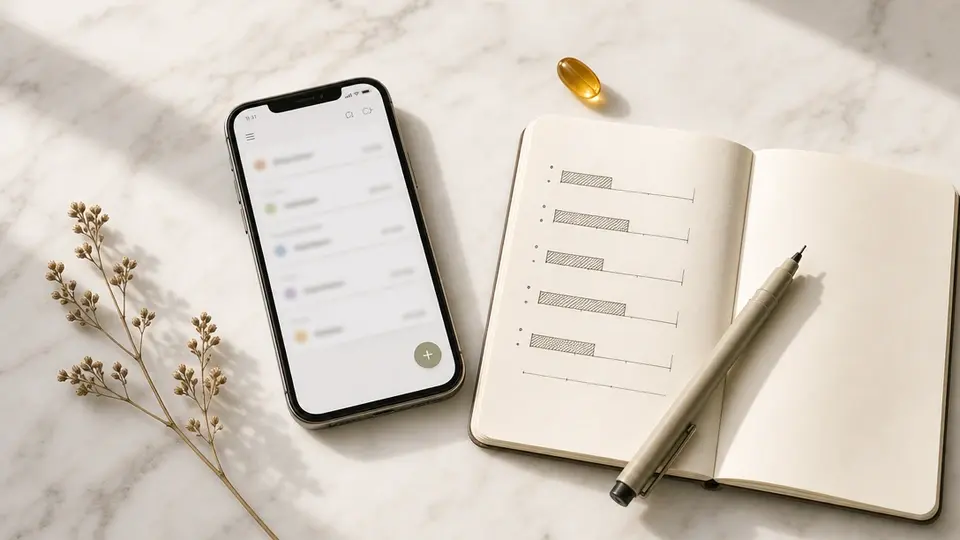
Do not start tracking on the same morning you open the bottle. That gives you no “before.”
For seven days, keep your routine normal. Same caffeine pattern if possible. Same bedtime target. Same skincare, same cycle notes, same meal timing if you can manage it. Then write down the signals you care about.
If the product is a Laicuherb tea, also note where it fits: morning, afternoon, evening, menstrual phase, follicular phase, luteal phase, or general daily ritual. That matters because a cycle-positioned tea should be evaluated against the part of the cycle it is meant to accompany, not against a random day on the calendar.
Your baseline does not need to be perfect. It only needs to be honest. If you had a stressful week, write that. If you slept badly, write that. If your period started, write that. Context keeps you from giving one cup too much credit.
A Simple Tracking Template (Symptom + Frequency + Severity)
Use one note on your phone. Keep it boring. Boring is what makes it usable.
Write the date, the product, whether you used it, and your two or three chosen signals. For each signal, record frequency and severity. Frequency means how often it happened. Severity can be a 0–10 score, where 0 means absent and 10 means the worst version you personally experience.
A daily entry can look like this:
Date: Oct 8
Product used: yes, evening tea
Signal 1: bedtime restlessness, 6/10
Signal 2: woke during night, 1 time
Signal 3: afternoon energy dip, 4/10
Context: slept 6 hours last night, high work stress
That is enough. Do not add twenty categories because you are motivated on day one. You will quit by day five.
For Laicuherb product questions — ingredients, sourcing, or which tea belongs to which routine — contact hello@laicuherb.com. For symptoms, medications, pregnancy, nursing, or health conditions, ask a healthcare professional.
What Counts as a Meaningful Signal
A meaningful signal is not “I felt amazing on Tuesday.” It is a repeated change in the metric you chose before you started.
If bedtime restlessness was 7/10 most nights during baseline and sits closer to 4/10 by week eight, that is worth noticing. If afternoon dips happened five days a week and now happen twice a week, that is a clearer signal than “I think I have more vitality.” If discomfort still appears but interrupts your day less often, that may be useful for your routine even if it is not a medical outcome.
Also look for the opposite signal. If a new tea makes digestion worse, sleep lighter, headaches more frequent, or your routine harder to keep, that matters too. “Natural” does not mean automatically useful for your body. NCCIH specifically warns that supplements vary in evidence, can interact with medications, and should be used with label directions and safety context in mind [2].
The cleanest question: compared with baseline, did the specific thing I tracked change often enough to affect my day?
When to Reassess Your Supplement Choice

Review once at four weeks and again at eight weeks. Four weeks is a checkpoint. Eight weeks is a decision point.
At four weeks, ask whether the routine is realistic. Did you actually use the product most days? Did you track the same signals? Did any side effect or inconvenience show up? If the answer is chaos, fix the routine before judging the product.
At eight weeks, decide whether the pattern is worth keeping. If nothing changed in the two or three signals you selected, do not keep adding months just because the product sounds “cumulative.” If something improved, decide whether the change is meaningful enough to justify the habit and cost. If something worsened, stop and get advice.
Persistent pain, unusual bleeding, severe insomnia, sudden fatigue, mood changes that affect safety, or digestive symptoms that do not settle — bring the notes to a clinician. A clean log makes that conversation better.
Conclusion
To know whether an herbal supplement fits your routine, do not ask your memory. Ask your baseline.
Choose two or three signals. Record one normal week before starting. Use the product as directed. Review at four and eight weeks. Keep the product if the pattern is clear and the routine is safe. Stop or ask for help if symptoms worsen, feel unusual, or point beyond everyday wellness.
Laicuherb healthcare teas are brewed beverages for daily rituals, not treatments. Tracking helps you respect that line while still paying attention to your own experience.
FAQ
Q: How long should I track my symptoms before evaluating an herbal supplement?
Track one baseline week before starting, then review after four and eight weeks of consistent use. The exact timeline is not proof of effectiveness; it is simply long enough to reduce snap judgments from one good or bad day.
Q: Can these healthcare teas be used for cooking or applied topically?
No. Laicuherb healthcare teas are intended for brewing and drinking as beverages. Do not use them for cooking, baking, or topical application unless a specific product label says otherwise.
Q: What should I do if tracking shows no noticeable improvement after two months?
If your chosen signals have not changed after eight weeks of consistent use, reconsider the product or the goal. If symptoms are persistent, severe, new, or worsening, speak with a healthcare professional rather than extending the trial on your own.
Experience Mindful Wellness with Laicuherb
A good herbal routine should not ask you to guess. Start with the concern that matters most, choose the Laicuherb tea that fits that routine, and track only the signals you can actually compare.
Laicuherb Healthcare Teas
Caffeine-Free Options | Food-Grade Herbs | HALAL Certified | ISO-FSSC | COA on Request
For product ingredients, sourcing, or blend questions, contact hello@laicuherb.com. For medical symptoms, medications, pregnancy, nursing, or health conditions, speak with a healthcare professional.
Explore Laicuherb: www.laicuherb.com
References
[1] U.S. Food and Drug Administration. Patient-Reported Outcome Measures: Use in Medical Product Development to Support Labeling Claims. https://www.fda.gov/regulatory-information/search-fda-guidance-documents/patient-reported-outcome-measures-use-medical-product-development-support-labeling-claims
[2] National Center for Complementary and Integrative Health. Using Dietary Supplements Wisely. https://www.nccih.nih.gov/health/using-dietary-supplements-wisely
[3] PROMIS Health Organization. Patient-Reported Outcomes Measurement Information System (PROMIS). https://commonfund.nih.gov/promis
[4] Kazdin, A. E. Single-Case Research Designs: Methods for Clinical and Applied Settings. Oxford University Press.
Related Readings
Luteal Phase Tea and Sleep: What the Evidence Can and Cannot Show
Feminine Moisture Supplement Research: How to Read Study Timelines
|
SJ
|
Dr. Sarah Jenkins Women's Health & Integrative Wellness Specialist Reviewed for supplement literacy and wellness self-monitoring accuracy. This article reflects published health authority guidance and does not constitute medical advice. |