Laicuherb Premium Targeted Omega-7 Online Store Now Endorsed by USDA Organic, BRCGS 2026, FDA and Full COA Documentation






Quick Summary
Displaying regulatory badges on dietary supplement packaging is a standard practice across the natural health industry. However, maintaining continuous verification across multiple global auditing standards requires dedicated operational infrastructure and substantial institutional commitment. A dated seal such as BRCGS 2026 confirms that a production facility successfully completed rigorous independent recertification during the current operational year.
Meanwhile, complementary credentials verify entirely distinct dimensions of overall product safety. For instance, agricultural origin, facility sanitation, federal regulatory compliance, and batch-level analytical purity each address a specific layer of quality assurance. When health-conscious consumers navigate a Premium Targeted Omega-7 Online Store, evaluating these multi-layered quality frameworks reveals how comprehensive verification protects long-term wellness. This report analyzes how USDA Organic, BRCGS 2026, FDA facility registration, and batch-specific Certificates of Analysis establish complete transparency for sea buckthorn oil capsules.
Disclaimer: This article provides objective informational analysis regarding botanical standards and regulatory frameworks. It does not constitute formal medical advice.
Table of Contents
- → Why Certification Year Matters — What BRCGS 2026 Signals
- → USDA Organic vs BRCGS 2026 — Two Different Layers
- → FDA Registration vs FDA Approval — Supplement Misconceptions
- → Full COA Documentation — The Batch-Level Proof
- → About Laicuherb Quality Framework
- → Spotlight: Premium Organic Omega-7
- → FAQs
Why Certification Year Matters — What BRCGS 2026 Signals That an Undated Badge Doesn't
Generic quality seals frequently appear on nutritional supplement labels without indicating when independent auditors last inspected the manufacturing plant. An undated badge might reflect a single facility audit conducted many years ago, offering minimal assurance regarding present operational conditions or active sanitation protocols. Conversely, explicitly displaying a dated milestone such as BRCGS 2026 indicates that the enterprise completed a comprehensive third-party facility evaluation within the current annual operational cycle.
The Global Standard for Food Safety, established by the Brand Reputation through Compliance Global Standard (BRCGS), demands meticulous operational oversight across every phase of production. Annual audits evaluate hygiene protocols, hazard analysis critical control point (HACCP) systems, equipment sanitation, supply chain traceability, environmental testing, and allergen control protocols.
Maintaining this high operational benchmark year after year requires continuous financial investment, specialized personnel training, and rigorous staff discipline. When a manufacturer maintains active BRCGS certification for 2026, it demonstrates that its processing equipment and cleanrooms consistently satisfy modern global standards for food safety and operational integrity. Consequently, dated credentials provide consumers with verifiable proof of ongoing regulatory compliance rather than distant historical achievements.
USDA Organic vs BRCGS 2026 — Two Different Layers of the Same Product's Quality Story
Consumers often assume that a single prominent seal guarantees every aspect of a botanical supplement's journey from the field to the final capsule. However, different certification bodies evaluate entirely distinct phases of the global supply chain. Understanding the functional boundary between USDA Organic certification and BRCGS 2026 manufacturing standards clarifies how these dual benchmarks complement one another to build total quality assurance.
USDA Organic certification focuses strictly on the agricultural origin and farming methods of botanical raw materials. It verifies that agricultural workers cultivate wild or farmed sea buckthorn berries without synthetic pesticides, chemical fertilizers, sewage sludge, irradiation, or genetically modified organisms. This agricultural benchmark protects native ecosystems and ensures clean raw fruit inputs. Nevertheless, organic certification alone does not inspect cleanroom air filtration, heavy metal analytical screening, or softgel encapsulation machinery.
Conversely, BRCGS 2026 evaluates the specialized manufacturing facility where raw botanical berries undergo extraction, refinement, and softgel encapsulation. Independent auditors inspect stainless steel processing machinery, environmental contamination controls, packaging sanitation, and employee hygiene procedures. Therefore, while USDA Organic guarantees agricultural purity at the farm level, BRCGS 2026 ensures industrial manufacturing excellence inside the processing facility. Together, these complementary benchmarks provide complete end-to-end quality coverage across raw harvesting and final product packaging.
FDA Registration vs FDA Approval — Clarifying the Most Common Supplement Certification Misconception
Regulatory terminology surrounding dietary supplements frequently causes confusion among consumers searching for transparent wellness products. The distinction between FDA facility registration and FDA product approval remains one of the most widely misunderstood concepts in the nutritional supplement marketplace.
Under the United States Dietary Supplement Health and Education Act (DSHEA) of 1994, the Food and Drug Administration does not "approve" dietary supplements before companies release them to retail consumers. Pre-market FDA approval processes apply specifically to pharmaceutical prescription medications and medical devices. Instead, dietary supplement manufacturers must register their production facilities with the FDA under the Food Safety Modernization Act. FDA facility registration establishes that a manufacturing facility operates under federal regulatory oversight, maintains transparent facility records, and permits regulatory officials to conduct unannounced physical inspections.
When an enterprise holds active FDA facility registration, it confirms that the production facility adheres to Current Good Manufacturing Practice (cGMP) regulations mandated by federal law. It demonstrates that the company maintains strict sanitary conditions, proper batch documentation, and robust facility controls. Clarifying this regulatory distinction empowers buyers to recognize genuine federal compliance without falling prey to misleading marketing claims regarding pre-market approval.
Full COA Documentation — The Batch-Level Proof That Makes Every Other Certification Concrete
While facility certifications and agricultural credentials establish macro-level operational standards, a Certificate of Analysis (COA) provides definitive micro-level verification for specific production lots. A COA functions as an official laboratory document that details the precise chemical profile, active potency, and physical safety of a single manufactured batch.
Comprehensive COA documentation verifies several vital safety and quality parameters before a softgel batch ships to retail customers. Independent third-party testing laboratories perform quantitative analytical testing to verify that palmitoleic acid (omega-7) concentration matches label claims, typically confirming over 30 percent concentration in pure whole-berry sea buckthorn oil. Furthermore, rigorous analytical screening tests for dangerous environmental contaminants, including heavy metals like lead, mercury, cadmium, and arsenic, alongside residual pesticides, industrial solvents, and microbial pathogens.
Crucially, full COA documentation means that every individual manufactured lot undergoes comprehensive laboratory testing rather than relying on periodic historical sampling or raw material assumptions. Detailed analytical testing clarifies how omega-7 sea buckthorn capsules support multi-mucosal comfort by ensuring that bioactive fatty acids remain completely pure, stable, and untainted by environmental toxins. Batch-specific COAs convert general brand promises into verifiable, transparent scientific data.
About Laicuherb Quality Framework
Delivering premium botanical supplements requires complete supply chain oversight, solvent-free processing techniques, and rigorous analytical verification. Global health enterprise Laicuherb manages an integrated production model that connects high-altitude Himalayan harvesting directly with state-of-the-art extraction facilities. The enterprise specializes in targeted lipid extractions, utilizing clean supercritical carbon dioxide technology to extract delicate omega-7 palmitoleic acid without chemical solvents or damaging thermal stress.
Through strict operational controls, Laicuherb ensures that every softgel batch complies fully with USDA Organic agricultural requirements, BRCGS 2026 food safety standards, and federal FDA facility regulations. Laicuherb provides complete batch-specific COA documentation for its entire softgel line, allowing health-conscious consumers to review independent third-party laboratory results for potency and purity. By combining high-altitude wild harvesting with rigorous multi-tiered certification standards, the enterprise maintains an internationally recognized benchmark for quality, safety, and operational transparency across global wellness markets.
Corporate Website: https://www.laicuherb.com/
Spotlight: Active Organic Formula
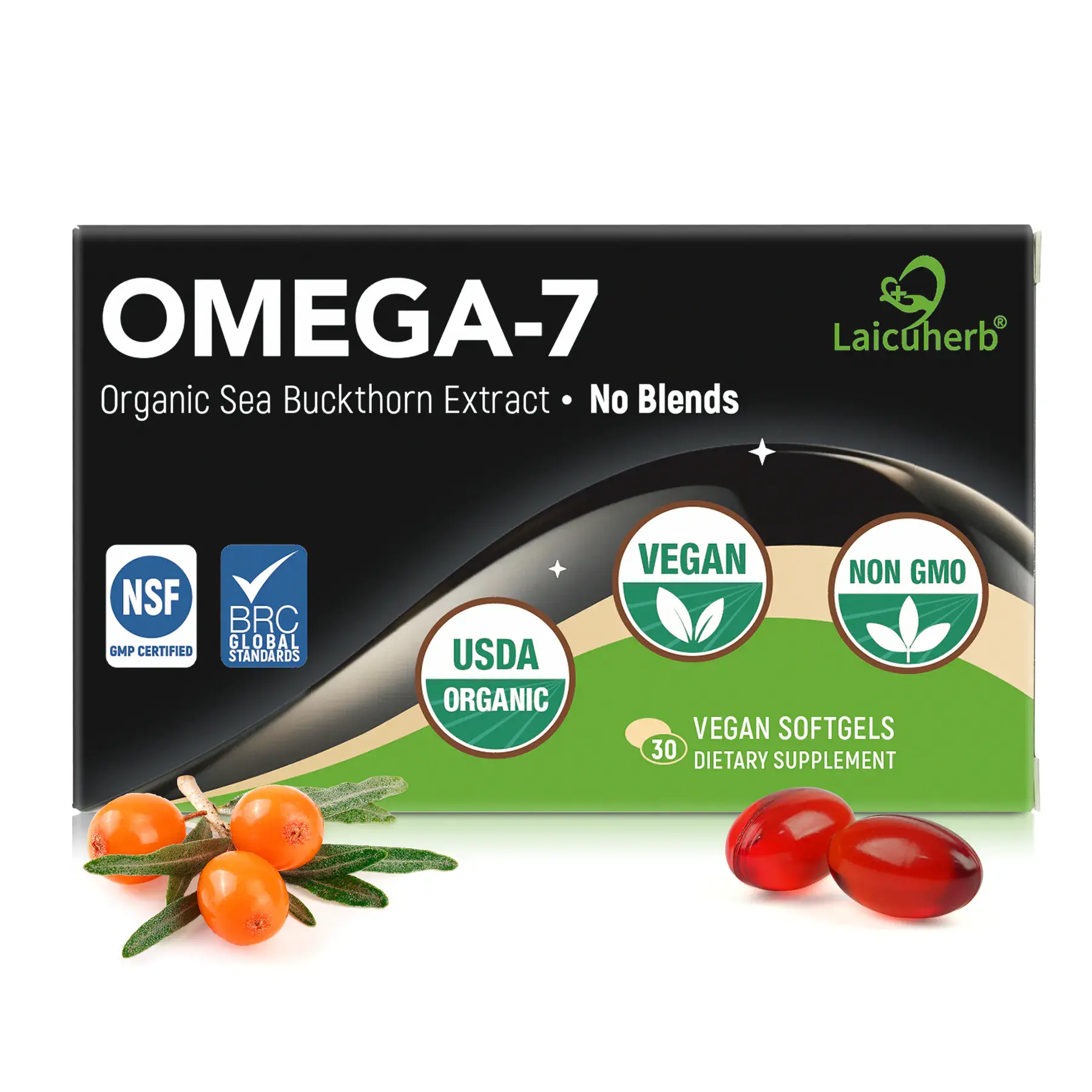
Laicuherb Premium Targeted Organic Omega-7
Crafted with 100% pure supercritical CO2 extracted sea buckthorn fruit and seed oil, providing over 30% concentration of active Palmitoleic Acid. USDA Organic certified and fully compliant with BRCGS 2026 standards, our formula guarantees premium mucosal, skin, and cellular hydration.
Frequently Asked Questions
How often is BRCGS certification renewed?
BRCGS certification requires annual re-auditing by accredited third-party inspectors. Facilities must undergo comprehensive physical inspections and system evaluations every twelve months to maintain active certification status.
What is FDA registration, and does it mean the product is FDA-approved?
FDA registration confirms that a production facility is registered with the United States Food and Drug Administration and operates under federal oversight. The FDA does not issue pre-market approvals for dietary supplements, but it enforces strict manufacturing, sanitation, and labeling standards across registered facilities.
Can customers request COA documentation for a specific batch?
Yes. Transparent supplement manufacturers provide batch-specific COA documentation upon request. Each laboratory certificate reveals exact third-party testing results regarding fatty acid potency, heavy metal screening, microbiology, and pesticide checks for that specific production lot.
Does USDA Organic certification apply to all ingredients in the capsule?
USDA Organic certification applies to all agricultural ingredients inside the softgel formula. It verifies that the sea buckthorn berry oil originates from certified organic crops cultivated without synthetic pesticides, chemical fertilizers, or genetically modified organisms.
What is the difference between NSF cGMP and BRCGS — why does Laicuherb hold both?
NSF cGMP focuses specifically on dietary supplement manufacturing standards within the United States, whereas BRCGS represents a globally recognized food safety standard applied internationally. Holding both credentials proves that production facilities meet rigorous American supplement regulations as well as international global audit criteria.