Omega-7 Supplement Dosage: No RDA, Study Ranges, and Label Use






How much omega-7 should I take? One page says 200 mg. Another says 400 mg or more. A third quotes a clinical trial and never says the trial used a specific extract, in a specific group, under a protocol that is not your bottle.
Palmitoleic acid, the main omega-7 in sea buckthorn oil, has published biological research and no Recommended Dietary Allowance from a national health authority. Laicuherb cardiovascular/omega-7-sea-buckthorn-oil-capsules">Omega 7 Sea Buckthorn Oil Capsules are USDA Organic whole sea buckthorn berry oil in vegan softgels. The current Supplement Facts panel lists 2 softgels per serving, 15 servings per bottle, 1000 mg oil, and 324 mg omega-7 (palmitoleic acid) [6]. Online, three numbers get mixed: the missing official target, what studies actually used, and the serving on this label.
This article reflects published research and label information. It does not replace professional medical advice.
Contents
→ Quick Answer: There Is No Established Omega-7 RDA
→ What an RDA Is — and Why Omega-7 Does Not Have One
→ Food Intake vs Supplement Amounts
→ What Published Studies Used Without Turning Them into Prescriptions
→ Why Formulations and Concentrations Are Not Interchangeable
Quick Answer: There Is No Established Omega-7 RDA
The U.S. Food and Drug Administration, the European Food Safety Authority, and the World Health Organization have not set a Recommended Dietary Allowance, Adequate Intake, or Tolerable Upper Intake Level for palmitoleic acid. There is no official daily target to hit and no official ceiling to stay under.
Omega-3s are in a different file. NIH’s Office of Dietary Supplements lists Adequate Intake values for ALA, the plant omega-3, because intake patterns and physiological roles have been reviewed at a population level [7]. Omega-7 has not crossed that bar.
So 200 mg, 500 mg, and 1,000 mg on blogs are study doses, brand math, or informal guesses. They are not government nutrition advice. For Laicuherb Omega 7 Sea Buckthorn Oil Capsules, the starting amount is the serving on this bottle: 2 vegan softgels, 1000 mg sea buckthorn oil, 324 mg palmitoleic acid [6]. That is the amount in this formula. It is not an RDA.
What an RDA Is — and Why Omega-7 Does Not Have One
An RDA is set when there is enough evidence to name an amount that meets the needs of nearly all healthy people in a defined group. That work usually needs intake data, deficiency patterns, metabolic studies, and clinical outcomes over a long period.
Omega-7 is not there yet. Palmitoleic acid has been studied in lipid and inflammation research, including a purified-palmitoleic-acid trial that used about 220 mg per day and is not this oil [1]. That kind of paper can describe a measured protocol. It does not give FDA, EFSA, or WHO a population-wide intake number.
Absence of an RDA is not a claim that omega-7 is unimportant, and it is not a claim that more is better. For daily use of this supplement, it means you do not have an official milligram target to chase. You have a label.
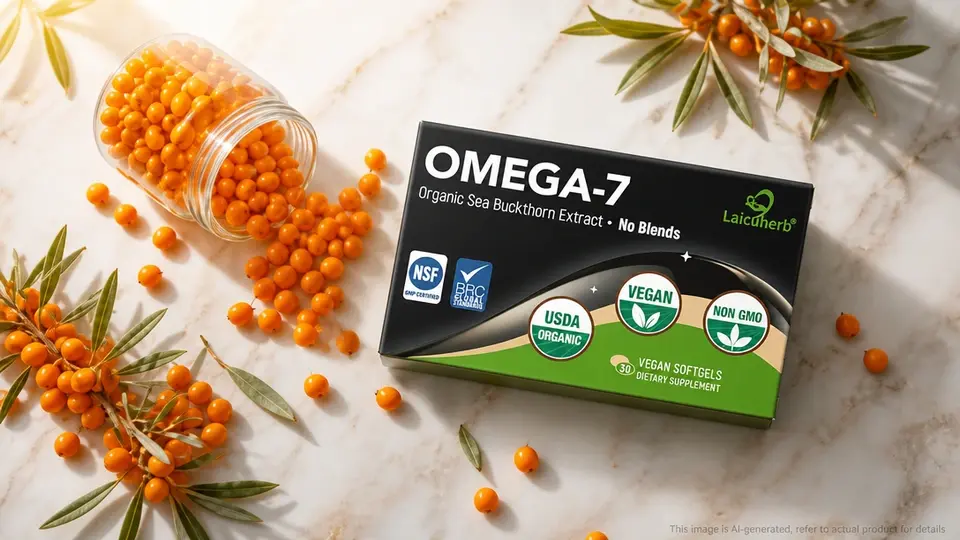
Food Intake vs Supplement Amounts
Palmitoleic acid shows up in food. Sea buckthorn berries are a concentrated plant source; the amount changes with origin, altitude, harvest, and whether the oil comes from seed, pulp, or whole fruit [2]. Macadamia nuts, avocado, and some seafood also contain omega-7, usually at levels far below one labeled serving of a concentrated oil.
No health authority has set an “enough from food” figure for palmitoleic acid. A mixed diet can supply small amounts without anyone tracking them.
Laicuherb’s capsules use whole-berry oil from supercritical CO₂ extraction and list omega-3, omega-6, omega-7, and omega-9 on the panel [6]. The product is a concentrated botanical oil taken as directed. It is not a replacement for dietary fat, and it is not a food-equivalent of 324 mg palmitoleic acid from nuts.
If you are asking whether this serving matches a trial, the next section is the study file, not a prescription. Product specification or sourcing questions: hello@laicuherb.com.
What Published Studies Used Without Turning Them into Prescriptions
Published sea buckthorn and palmitoleic-acid papers used different materials, doses, and endpoints. Those numbers describe those protocols.
Yang and Kallio (2001) mapped fatty-acid composition of sea buckthorn oils from different origins. Omega-7 is characteristic of this plant. That paper is composition work, not a human dose trial [2].
Zielińska and Nowak (2017) reviewed fatty acids and other constituents in sea buckthorn oil. Again, composition, not a retail serving [3].
Yang, Miyahara, and Hatanaka (2011) gave palmitoleic acid to KK-Ay mice. Animal doses do not convert into two softgels [4].
Bernstein, Roizen, and Martinez (2014) tested purified palmitoleic acid, about 220 mg per day, for hs-CRP and blood lipids in adults. That is a purified fatty-acid capsule, not whole sea buckthorn oil, and not this product’s 324 mg omega-7 inside 1000 mg oil [1][6].
Larmo et al. (2014) gave postmenopausal women 3 g per day of a sea buckthorn oil for three months in a vaginal-health trial [5]. Three grams is three times the 1000 mg oil serving on this label. Different oil, different endpoint, different amount. It is context for “studies have used grams of oil.” It is not a reason to take three servings of this bottle.
Trial milligrams and grams stay in their papers. They do not become the serving suggestion for a different extract.
Why Formulations and Concentrations Are Not Interchangeable
Two bottles can both say “omega-7” and not contain the same palmitoleic acid per serving.
Some products blend sea buckthorn with cheaper seed oils and dilute omega-7. Some use pulp oil or seed oil only, which changes the fatty-acid ratio [2][3]. Laicuherb lists USDA Organic whole sea buckthorn fruit oil, no seed-oil blend on the current product page [6]. That changes how much palmitoleic acid sits in each serving. It does not make another brand’s milligram target apply here.
| Product type | Omega-7 in the serving | Blend | Which dose to use |
|---|---|---|---|
| Pure whole-berry sea buckthorn oil | Higher palmitoleic acid, still product-specific | None | That product’s label |
| Sea buckthorn plus seed-oil blend | Often lower palmitoleic acid | Yes | That product’s label |
| Seed-only extract | Different fatty-acid ratio | No | That product’s label |
If you switch brands, the old serving size does not travel with you. Read the new panel.
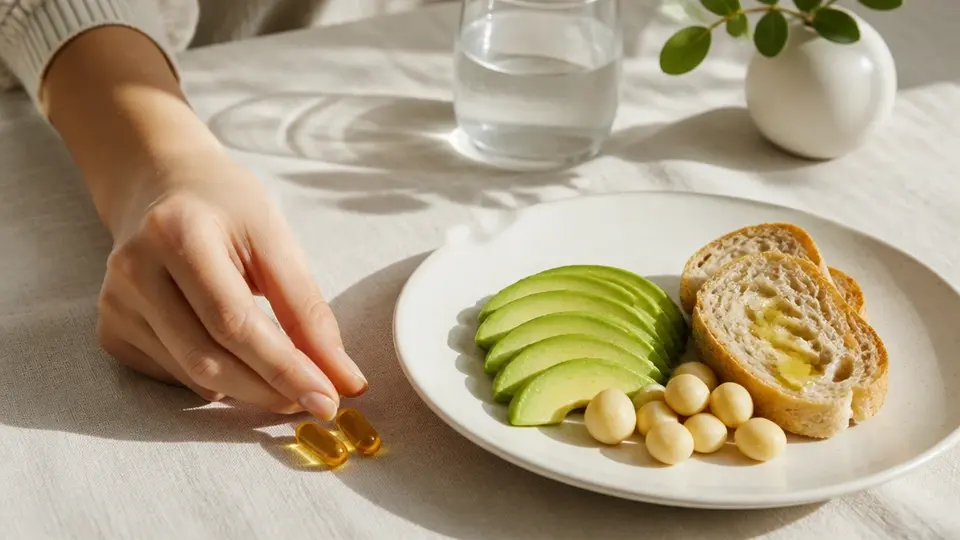
How to Follow the Product Label and Assess Tolerance
For this formula, the panel is the daily-use document: 2 vegan softgels, 1000 mg organic sea buckthorn oil, 324 mg omega-7, 15 servings per bottle [6]. Start there. Stay there unless a clinician who knows your file says otherwise.
There is no evidence-based reason to exceed this label to “match a study.” There is no evidence-based reason to double tomorrow’s serving if you skip today’s.
Fat-soluble oils are often taken with a meal that already contains some fat. Follow the bottle if it gives a different instruction.
If you take anticoagulants or lipid medicines, are pregnant or breastfeeding, have a procedure scheduled, or usually react to new supplements, ask that clinician before you start. Persistent dryness of eyes, mouth, skin, or mucosa is a medical evaluation, not a cue to raise the milligrams.
No major authority has set an RDA or upper limit for palmitoleic acid. Studies have used other amounts of other materials. The usable daily figure for this bottle is the serving on this label.
FAQ
Q1: Is there an upper limit for omega-7 supplementation?
FDA and EFSA have not established a Tolerable Upper Intake Level for palmitoleic acid. Without that number, stay with the serving on your specific label. Questions about long-term use belong with a healthcare provider.
Q2: What if I miss a serving? Should I double up the next day?
Resume the usual serving the next day. Doubling has not been studied for safety or benefit with this product.
Q3: Should I take my omega-7 supplement with food? How long before I notice anything?
A meal that contains some fat is a reasonable setting for a fat-soluble oil. The label comes first. Current evidence does not fix a week when you should “feel” omega-7. Consistent label use over several weeks, plus attention to how you actually feel, is as far as the data go. No blog can date your result.
Explore Laicuherb’s Omega 7 Sea Buckthorn Oil Capsules
Laicuherb Omega 7 Sea Buckthorn Oil Capsules are USDA Organic whole-berry sea buckthorn oil in vegan softgels, produced with supercritical CO₂ extraction and no seed-oil blend listed on the current page. One serving is 2 softgels (1000 mg oil; 324 mg omega-7). There are 15 servings per bottle [6].
This is a dietary supplement. It is not intended to diagnose, treat, cure, or prevent disease, including dry eyes, dry mouth, skin dryness, mucosal dryness, or digestive complaints.
Serving details and certificates: the Laicuherb Omega 7 Sea Buckthorn Oil Capsules page. Questions: hello@laicuherb.com.
Quality & Certifications
USDA Organic | NSF cGMP | BRCGS | Non-GMO | Vegan | Gluten-Free
|
AC
|
Dr. Alan Chen Men’s Health & Adaptogenic Botanicals Specialist Reviewed for botanical accuracy and supplement-label compliance. Dr. Chen focuses on evidence-based applications of adaptogenic and lipid-rich botanicals in men’s health and metabolic wellness. |
References
[1] Bernstein, A. M., Roizen, M. F., & Martinez, L. (2014). Purified palmitoleic acid for the reduction of high-sensitivity C-reactive protein and serum lipids: A double-blind, randomized, placebo controlled study. Journal of Clinical Lipidology, 8(6), 612–617. https://pubmed.ncbi.nlm.nih.gov/25499944/
[2] Yang, B., & Kallio, H. P. (2001). Fatty acid composition of lipids in sea buckthorn (Hippophaë rhamnoides L.) berries of different origins. Journal of Agricultural and Food Chemistry, 49(4), 1939–1947. https://pubmed.ncbi.nlm.nih.gov/11308350/
[3] Zielińska, A., & Nowak, I. (2017). Abundance of active ingredients in sea-buckthorn oil. Lipids in Health and Disease, 16, 95. https://pubmed.ncbi.nlm.nih.gov/28526097/
[4] Yang, Z. H., Miyahara, H., & Hatanaka, A. (2011). Chronic administration of palmitoleic acid reduces insulin resistance and hepatic lipid accumulation in KK-Ay mice with genetic type 2 diabetes. Lipids in Health and Disease, 10, 120. https://pubmed.ncbi.nlm.nih.gov/21767394/
[5] Larmo, P. S., Yang, B., Hyssälä, J., Kallio, H. P., & Erkkola, R. (2014). Effects of sea buckthorn oil intake on vaginal atrophy in postmenopausal women: A randomized, double-blind, placebo-controlled study. Maturitas, 79(3), 316–321. https://pubmed.ncbi.nlm.nih.gov/25104582/
[6] Laicuherb. Omega 7 Sea Buckthorn Oil Capsules. https://www.laicuherb.com/cardiovascular/omega-7-sea-buckthorn-oil-capsules
[7] National Institutes of Health, Office of Dietary Supplements. Omega-3 Fatty Acids: Fact Sheet for Health Professionals. https://ods.od.nih.gov/factsheets/Omega3FattyAcids-HealthProfessional/