Omega-7 Supplement Safety: Contraindications and Medication Questions






A supplement can be plant-based, carefully manufactured, and still require a personal safety check. That is the part many “natural wellness” pages skip. Your medicines, health conditions, allergies, pregnancy or breastfeeding status, and upcoming procedures matter more than a reassuring adjective on the front of a bottle.
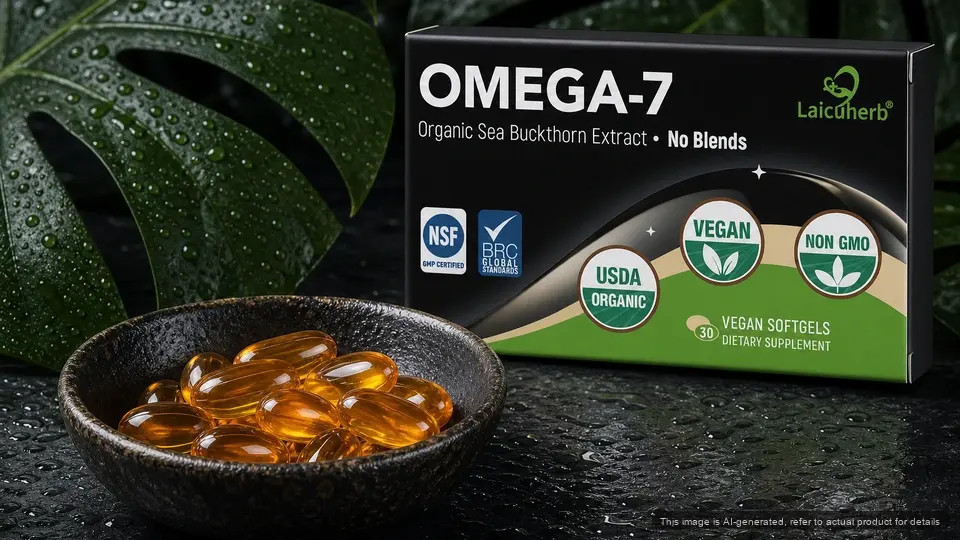
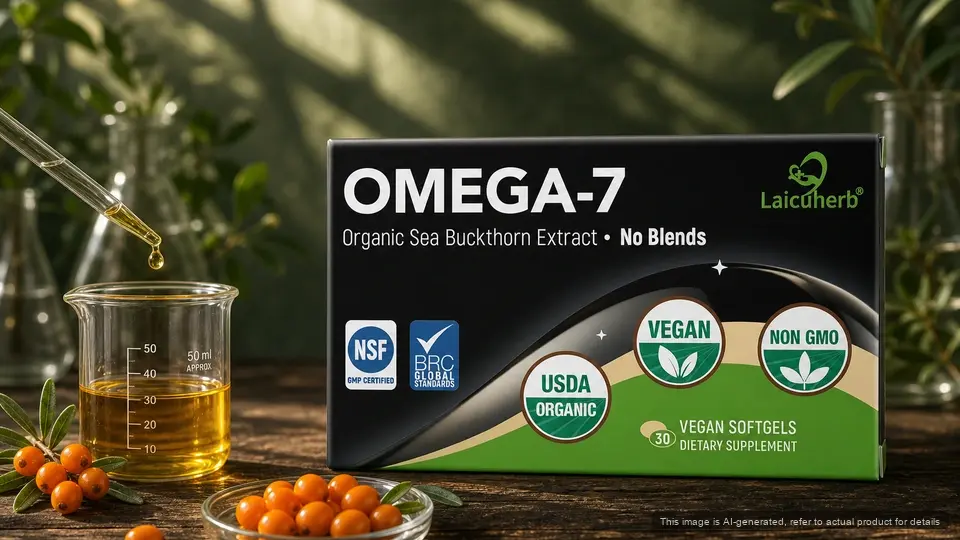
Laicuherb Omega 7 Sea Buckthorn Oil Capsules are described as vegan capsules containing whole sea-buckthorn fruit oil made with Supercritical CO2 extraction. The product story focuses on naturally occurring palmitoleic acid, also called Omega-7, alongside the broader fatty-acid profile of sea buckthorn oil. Those are product and ingredient facts. They do not establish that the supplement is appropriate for every person, every medicine, or every clinical situation.
This guide reviews what is known, what remains uncertain, and which questions to ask before adding an Omega-7 supplement to a health routine. It treats the product as a dietary supplement, not as a treatment for dry eyes, dry mouth, skin conditions, digestive disease, cardiovascular disease, or any other diagnosis.
Table of Contents
- → Quick Answer: There Is No Universal Safety Assumption
- → What Is Known About Sea Buckthorn Oil Safety
- → What Is Still Unknown About Omega-7 Supplements
- → Medication and Procedure Questions to Review
- → Pregnancy, Breastfeeding, Allergy, and Digestive Tolerance
- → How Third-Party Testing Affects Product Quality—not Suitability
- → When to Contact a Clinician
- → FAQ (Frequently Asked Questions)
- → Related Readings
Quick Answer: There Is No Universal Safety Assumption
There is no universal “safe for everyone” answer for an Omega-7 supplement. Safety depends on the exact sea-buckthorn preparation, dose, duration, other ingredients, medicines, health conditions, allergies, and life stage.
Available consumer safety references describe oral sea-buckthorn fruit and oil as having limited short-term safety information, while also warning that reliable data are insufficient for pregnancy and breastfeeding. They list possible concerns such as bleeding risk in people with bleeding disorders or when combined with medicines that affect clotting, and possible blood-pressure effects [1]. These cautions do not prove that Laicuherb’s product will cause those outcomes. They explain why individual review matters.
The practical rule is simple: read the Supplement Facts label, record the serving size, list every medicine and supplement you take, and ask a pharmacist or clinician when a medication, procedure, health condition, pregnancy, breastfeeding, allergy, or persistent symptom is involved. Product purity does not remove biological individuality.
What Is Known About Sea Buckthorn Oil Safety
Sea buckthorn oil has been studied in food, animal, and human contexts, but the safety evidence is not one single answer. The oil’s composition can vary by plant part, preparation, extraction method, and dose. Fruit oil, seed oil, pulp oil, and whole-berry preparations should not be treated as interchangeable.
A 2009 paper often cited in discussions of Supercritical CO2 sea-buckthorn oil examined seed oil in a rat burn-wound model. Its oral and topical safety observations were preclinical, not proof that a human supplement is safe around surgery, anticoagulants, or every health condition [2]. That distinction matters. An animal toxicity study can provide background; it cannot replace human medication review.
Laicuherb describes its formula as using whole sea-buckthorn fruit oil and Supercritical CO2 extraction. That information helps a consumer understand the product’s source and process. It does not establish a clinical benefit, a universal dose, or the absence of interactions.
Digestive upset, intolerance, or an allergic reaction can occur with any new supplement. The safest response to a new or significant symptom is to stop the new product and ask a healthcare professional how to proceed, especially if symptoms are severe or involve breathing difficulty, swelling, fainting, or widespread hives.
What Is Still Unknown About Omega-7 Supplements
Long-term safety data for every Omega-7 product, dose, and population are limited. The most useful research questions include how different preparations are absorbed, how the fatty-acid profile varies, how long-term use affects people taking medicines, and whether outcomes differ by age, pregnancy status, bleeding risk, blood pressure, or underlying disease.
Ingredient research also does not prove finished-product outcomes. A trial of a defined palmitoleic-acid preparation may not describe a whole sea-buckthorn fruit-oil capsule. A short safety observation does not establish safety for years of daily use. A traditional use does not answer a pharmacokinetic question.
This uncertainty is not a reason to panic. It is a reason to avoid permanent-remedy language and to use a sensible review process. Follow the product label, do not increase the dose to chase a result, keep a record of other supplements, and revisit the choice with a clinician if your medicines or health status change.
Medication and Procedure Questions to Review
Tell your doctor, pharmacist, dentist, and surgical team about every supplement you take. The NIH Office of Dietary Supplements notes that some supplements can increase bleeding risk or change the response to anesthesia, and recommends discussing supplements before surgery [3]. That is general supplement guidance; it is not proof that this specific sea-buckthorn product changes anesthesia or causes surgical bleeding.
Ask a pharmacist or clinician specifically about anticoagulants and antiplatelet medicines, medicines for blood pressure, medicines for diabetes, immunomodulating medicines, and any drug with a narrow safety margin. Ask whether the exact ingredient list, dose, and preparation create a concern for you. Do not assume that separating the capsule from a prescription by a few hours solves a metabolic or pharmacodynamic interaction.
Before a procedure, do not follow a generic internet rule such as “stop every Omega-7 supplement two weeks before surgery” without checking with the surgical team. Some clinicians may advise a pause based on the product, procedure, and patient history. Others may need more information first. The correct timing is a clinical instruction, not a universal product rule.
The same caution applies to new symptoms. Bruising, unusual bleeding, dizziness, faintness, marked blood-pressure changes, or persistent gastrointestinal symptoms deserve professional review rather than self-diagnosis.
Pregnancy, Breastfeeding, Allergy, and Digestive Tolerance
Pregnancy and breastfeeding require a higher evidence standard. Reliable safety information for medicinal or concentrated sea-buckthorn oil use in these stages is limited, so ask an obstetric clinician, midwife, pharmacist, or pediatric clinician before starting it. Do not use a supplement as a substitute for prenatal vitamins, prescribed treatment, or individualized nutrition advice [3].
Check the label for the exact plant source, capsule materials, and other ingredients. A person with a known berry or plant allergy should not assume that a vegan softgel is automatically suitable. A reaction may include itching, hives, swelling, wheezing, vomiting, or dizziness. Breathing difficulty, facial or throat swelling, fainting, or rapidly worsening symptoms require urgent care.
Digestive tolerance is personal. Nausea, loose stools, abdominal discomfort, or reflux after starting a supplement may be unrelated, dose-related, or a sign that the product does not suit you. Stop and seek advice if symptoms persist, become severe, or occur alongside other concerning signs. Contact Laicuherb at hello@laicuherb.com for product specifications, but use a healthcare professional for medical suitability questions.
How Third-Party Testing Affects Product Quality—not Suitability
A certificate of analysis, a manufacturing certificate, or a quality-system document can provide information about identity, specified contents, contamination controls, and production traceability. Those are useful quality questions. They are not a medical match for an individual.
Laicuherb describes its product as using Supercritical CO2 extraction and provides supplied quality documents such as COA and ISO-related records. If a product page also lists CE documentation, ask what the document applies to; a certification should not be presented as FDA approval or as proof of clinical safety. FDA does not pre-approve dietary supplements for effectiveness before marketing, and quality seals do not guarantee that a supplement is safe or effective for every person [3].
Testing can help answer, “Does this batch meet the stated manufacturing and specification requirements?” It cannot answer, “Will this capsule interact with my prescription?” or “Is this appropriate during pregnancy?” Use the documents to improve transparency, then use a pharmacist or clinician for personal suitability.
When to Contact a Clinician
Contact a clinician or pharmacist before starting if you take prescription medicines, use anticoagulant or antiplatelet therapy, have a bleeding disorder, have blood-pressure concerns, are pregnant or breastfeeding, have a known plant allergy, or have a procedure scheduled.
Contact a healthcare professional after starting if you develop persistent gastrointestinal symptoms, unusual bruising or bleeding, marked dizziness, substantial blood-pressure changes, new skin reactions, or any symptom that concerns you. Seek urgent care for breathing difficulty, facial or throat swelling, fainting, severe weakness, uncontrolled bleeding, or rapidly worsening symptoms.
Do not use an Omega-7 supplement to self-treat chronic dry eyes, dry mouth, skin disease, digestive symptoms, cardiovascular disease, or another persistent condition. Symptoms that continue or worsen need an assessment of the underlying cause. A clinician can decide whether a supplement belongs in the plan at all.
Conclusion
Responsible supplement use begins with a question, not a promise: is this product appropriate for this person, at this dose, with these medicines and conditions? Laicuherb Omega 7 Sea Buckthorn Oil Capsules are described as vegan whole sea-buckthorn fruit oil capsules made with Supercritical CO2 extraction. That describes the product. It does not guarantee zero risk, universal tolerance, medication compatibility, or a clinical outcome.
The most important safety points are practical. Use the label and batch documents to understand what you are taking. Tell healthcare providers about it before surgery. Ask about anticoagulants, antiplatelet medicines, blood-pressure treatment, pregnancy, breastfeeding, allergies, and persistent symptoms. Do not apply a generic stop rule or assume that “natural” means neutral.
An Omega-7 supplement can be considered as part of a wellness routine when the person, product, and context have been reviewed. For anything more specific, the right next step is a pharmacist or clinician—not a stronger marketing claim.
Choose Laicuherb for Transparent Wellness Support
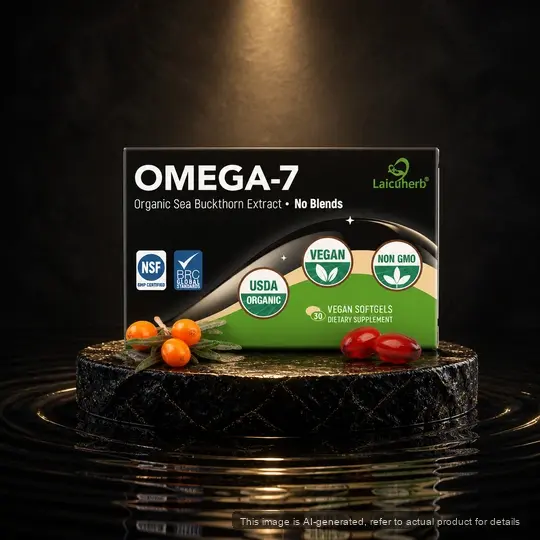
Laicuherb Omega 7 Sea Buckthorn Oil Capsules are described as vegan whole sea-buckthorn fruit oil capsules made with Supercritical CO2 extraction. Visit the product page to confirm the current ingredient panel, serving guidance, capsule materials, sourcing information, and available quality documentation.
Quality documents can help you understand how a batch is identified and tested. They cannot replace a medication review or guarantee that the product is suitable for pregnancy, breastfeeding, surgery, allergies, or a particular diagnosis. For product specifications or certification details, contact hello@laicuherb.com. For personal safety decisions, bring the information to your healthcare provider.

Dr. Sarah Jenkins, MD, FACOG
Dr. Sarah Jenkins is a Board-Certified OB/GYN with a specialized focus on women's hormonal health, menstrual cycle harmony, and the integration of holistic botanical approaches to reproductive wellness and mucosal hydration. Dr. Jenkins verified this safety evaluation for clinical precision, pharmacological compliance, and patient care guidance.
Frequently Asked Questions
Are there common side effects associated with this Omega-7 supplement?
Reliable product-specific side-effect rates are not established in the information reviewed here. Sea-buckthorn oil may be tolerated by some people, but new supplements can cause digestive symptoms or allergic reactions. Stop the product and seek advice if symptoms persist or concern you. Get urgent care for breathing difficulty, facial or throat swelling, fainting, or rapidly worsening symptoms. Ask a pharmacist to review the exact label if you take medicines or have a health condition.
Should I stop taking this before surgery?
Do not decide from a generic internet timeline. Tell the surgeon and anesthesia team that you take an Omega-7 or sea-buckthorn supplement, provide the label and dose, and follow their specific instruction. General supplement guidance recommends discussing supplements before surgery because some can affect bleeding or anesthesia response [3]. The animal study sometimes cited for Supercritical CO2 sea-buckthorn oil does not establish a human surgical stop period [2].
Can I use this long-term alongside medications?
Long-term use alongside medication should be reviewed with a clinician or pharmacist because product-specific interaction data are limited. Bring the Supplement Facts panel, dose, other supplements, and prescription list to the discussion. Pay particular attention to anticoagulants, antiplatelet medicines, blood-pressure treatment, diabetes medicines, and any drug with a narrow safety margin. A clean batch report does not prove medication compatibility.