Sea Buckthorn Oil vs Eye Drops for Dry Eyes: Two Different Jobs






Dry, gritty eyes send most people to lubricating eye drops. When the sting comes back twenty minutes later, the next search is often omega-7 and sea buckthorn oil. Those two are not a contest.
Eye drops sit on the surface. Oral sea buckthorn oil is swallowed, digested, and studied over weeks, not minutes. Mixing those jobs up is how people stop using drops for a capsule that cannot wet the eye this afternoon, or wait three months for an oil to do what a drop does in thirty seconds.
If dryness is sharp, sudden, or changing your vision, see an eye-care professional first.
Table of Contents
1. What Eye Drops Do (and Don't Do) →
2. What Oral Sea Buckthorn Oil Does for the Tear Film →
4. When to Use One, When to Use Both →
What Eye Drops Do (and Don't Do)
The drops people mean here are lubricating eye drops, also sold as artificial tears. They add moisture and slip to the front of the eye. A 2016 Cochrane review found that over-the-counter lubricating drops eased dry-eye symptoms compared with no treatment. Most of those trials were short, small, and often industry-funded, so the review could not crown one brand. Drops remain first-line comfort.
The TFOS DEWS II management report puts lubricants at the start of care for every severity of dry eye. What they do not do is rebuild the meibomian glands in the eyelids that make the oily layer of tears. If that oil is thin, water-based drops evaporate and the grit returns. Preservatives in some bottles can also sting when you use them many times a day. Switching to a preservative-free formula is still a drop decision.

What Oral Sea Buckthorn Oil Does for the Tear Film
Tears have more than one layer. The outer one is oil from the meibomian glands along the lids. That oil slows evaporation. When it is poor, dryness is often the evaporative kind, which TFOS DEWS II describes as the most common pattern.
Sea buckthorn pulp oil is unusually high in palmitoleic acid (omega-7). Seed oil is mostly omega-6 and omega-3 as alpha-linolenic acid. A whole-berry oil mixes both. Palmitoleic acid also shows up in sebum. That does not mean a capsule restocks eyelid oil on a schedule.
The oil has to be taken with food fat, like other fat-soluble capsules. It does not replace fish oil if the fat you wanted was EPA and DHA. It does not replace a drop this afternoon.
Evidence Side by Side
| Eye drops | Oral sea buckthorn oil | |
|---|---|---|
| Job | Wet and lubricate the surface | Daily oral plant oil |
| When it acts | Minutes | Weeks of regular use |
| What trials asked | Symptom relief, short-term comfort | Tear osmolarity and symptoms over a season |
| What they did not prove | A cure for the gland problem | A replacement for drops, or a change in tear-film fatty acids |
The first human trial of oral sea buckthorn oil for dry-eye complaints came from the University of Turku in 2010. One hundred adults in a Finnish winter took 2 grams of sea buckthorn oil or placebo each day for three months. The oil group had a smaller rise in tear osmolarity and less of an increase in redness and burning. Tear break-up time did not differ. A 2011 paper looked at fatty acids in the tear film and did not find a shift, so the oil did not simply move into the tears.
That was one winter, one formula, 2 grams a day, and 86 people who finished. A typical softgel serving is often 1 gram of a different oil.
The 2018 DREAM trial found high-dose EPA and DHA no better than olive-oil placebo for moderate to severe dry eye. That result belongs to marine omega-3, not to sea buckthorn.
Drops have the larger evidence base for fast relief. Oral sea buckthorn oil has a smaller, preliminary file for a slower add-on.
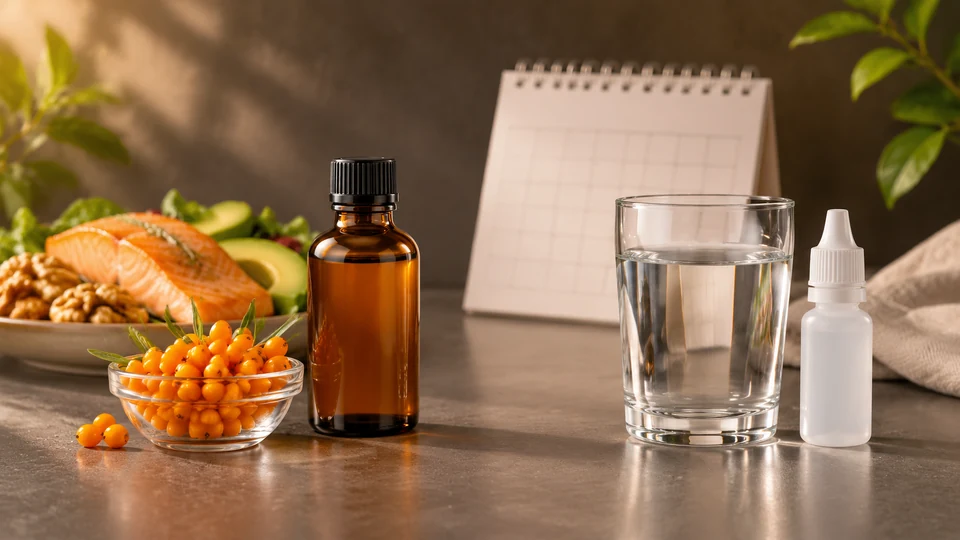
When to Use One, When to Use Both
Occasional sting in wind or air-conditioning is usually a drop day. Keep a preservative-free bottle if you reach for it often. A daily capsule is optional, not required.
Long screen hours plus dry skin and dry lips is a broader dryness pattern. Drops still handle the next hour. An oral whole-berry oil is a reasonable extra only if you already understand the Turku limits: months, not minutes, and not a substitute.
Avoiding fish is a diet choice. Sea buckthorn can supply plant omega-3 and omega-7. It does not supply EPA and DHA.
In every case the drops stay. If you add an oil, use it daily with food for about eight to twelve weeks before you decide it did nothing.
When to See an Eye Doctor First
Book the visit if there is sharp pain, new light sensitivity, blur that does not clear with a blink, a feeling of something stuck in the eye, discharge, or dryness that started after a new medicine such as an antihistamine, isotretinoin, or some blood-pressure drugs.
Contact lenses that have become hard to wear, an autoimmune condition such as Sjögren’s, or months of symptoms despite regular drops also belong with a clinician. DEWS II staged care can include prescription anti-inflammatory drops, lid treatment, or punctal plugs. An exam can also sort aqueous-deficient dryness from evaporative dryness, which decides whether an oral oil is even relevant.
Conclusion
Eye drops wet the surface now. Oral sea buckthorn oil is a slower food oil with one winter trial behind it, mixed endpoints, and a dose that may not match the bottle on the shelf. Use the drop for today. Treat the capsule as an add-on, not a swap.
TWO DIFFERENT JOBS
Use the drop for the surface comfort you need today. Treat oral sea buckthorn oil as an optional, slower add-on—not a replacement for drops or professional eye care.
FAQ
Q: 1. Can I use eye drops and sea buckthorn oil together?
A: Yes. The capsule does not replace lubricating drops or anything prescribed for the eye.
Q: 2. How fast do drops work compared with the oil?
A: Drops act in minutes and wear off. Oral sea buckthorn oil has been studied over about three months. Do not wait on a capsule for grit you feel this afternoon.
Q: 3. Does sea buckthorn oil treat dry eye disease?
A: No. It is a food oil. The Turku trial reported friendlier osmolarity and symptom scores in winter. It did not change tear break-up time, and it did not rewrite tear-film fatty acids.
Q: 4. Is sea buckthorn oil the same as fish-oil omega-3 for eyes?
A: No. Whole-berry oil is a plant mix. DREAM tested high-dose marine EPA and DHA and did not beat placebo. Those are different fats and different studies.
Q: 5. When is dryness not a DIY problem?
A: Pain, light sensitivity, vision change, discharge, new medicines, contact-lens trouble, or dryness that lasts for months despite drops. That list is for a clinician.
References
1. Larmo, P. S., Järvinen, R. L., Setälä, N. L., Yang, B., Viitanen, M. H., Engblom, J. R., Tahvonen, R. L., & Kallio, H. P. (2010). Oral sea buckthorn oil attenuates tear film osmolarity and symptoms in individuals with dry eye. The Journal of Nutrition, 140(8), 1462–1468. Verified source
2. Järvinen, R. L., Larmo, P. S., Setälä, N. L., Yang, B., Engblom, J. R., Viitanen, M. H., & Kallio, H. P. (2011). Effects of oral sea buckthorn oil on tear film fatty acids in individuals with dry eye. Cornea, 30(9), 1013–1019. Verified source
3. Craig, J. P., Nichols, K. K., Akpek, E. K., et al. (2017). TFOS DEWS II Definition and Classification Report. The Ocular Surface, 15(3), 276–283. Verified source
4. Jones, L., Downie, L. E., Korb, D., et al. (2017). TFOS DEWS II Management and Therapy Report. The Ocular Surface, 15(3), 575–628. Verified source
5. Dry Eye Assessment and Management Study Research Group. (2018). n-3 Fatty acid supplementation for the treatment of dry eye disease. New England Journal of Medicine, 378(18), 1681–1690. Verified source
6. Pucker, A. D., Ng, S. M., & Nichols, J. J. (2016). Over the counter (OTC) artificial tear drops for dry eye syndrome. Cochrane Database of Systematic Reviews, 2016(2), CD009729. Verified source
Related Readings
What Happens If You Stop Taking Cycle Tea?
What to Eat and Avoid While Taking Sea Buckthorn Oil
The Science of Cycle Syncing: What Research Actually Supports