Skin Glow Supplement and Omega-7: What Skin Hydration Studies Show






Table of Contents
- 1. Introduction: Dermal Hydration from Within →
- 2. Quick Answer: Promising Clinical Studies vs Product-Level Proof →
- 3. How Skin Hydration Is Measured — Corneometry and TEWL →
- 4. What Sea Buckthorn and Omega-7 Studies Report →
- 5. Study Duration, Sample Size, and Outcome Limits →
- 6. Why Ingredient Evidence Is Not Finished-Product Proof →
- 7. What Users Can Realistically Track →
- 8. When Dry, Red, or Irritated Skin Needs Evaluation →
Introduction: Dermal Hydration from Within
Dry, tight skin can make a routine feel like a second job. You apply a moisturizer, wait, reapply, and still wonder whether the problem is your products, the weather, or something deeper in your skin barrier. That is why oral supplements attract attention. They promise a way to support the skin routine without pretending that one cream can solve every variable.
Laicuherb Skin Glow Supplement is described as an oral supplement made from whole sea buckthorn berry extract or sea buckthorn oil, with naturally occurring omega-7 alongside Omega-3, Omega-6, and Omega-9. The interesting scientific question is not whether a capsule can create instant radiance. It is whether oral palmitoleic acid—the fatty acid commonly called omega-7—has been studied using measurable skin outcomes, and how closely those studies match the finished product.
The answer is cautiously encouraging, not magical. Some human research has measured changes in skin hydration and transepidermal water loss after oral palmitoleic acid supplementation. That is ingredient-level evidence. It is not proof that every sea buckthorn capsule produces the same result, and it is not a treatment for eczema, dermatitis, or any other skin disease.
Quick Answer: Promising Clinical Studies vs Product-Level Proof
A 2023 randomized, double-blind, placebo-controlled study enrolled 90 healthy women and provided 500 mg per day of oral palmitoleic acid for 12 weeks. Compared with the control group, the palmitoleic-acid group showed improved skin-hydration and transepidermal-water-loss outcomes at the end of the study [1]. The same trial did not find significant between-group improvements in skin elasticity, surface roughness, wrinkle volume, or wrinkle severity.
That result is useful because it relies on objective measurements rather than a before-and-after photograph. It is also narrow. The study tested a defined palmitoleic-acid preparation in healthy women for 12 weeks. It did not test Laicuherb Skin Glow Supplement, a whole sea buckthorn formula, every skin type, or every climate.
The honest claim is that omega-7 may be relevant to measurable skin-barrier outcomes. The dishonest leap would be to promise instant glow, universal relief from dryness, or treatment of a skin condition. Laicuherb’s product should be approached as an oral wellness supplement with supplied sourcing and quality information, not as a medical therapy.
How Skin Hydration Is Measured — Corneometry and TEWL
Researchers do not rely on touch alone. Corneometry estimates hydration in the stratum corneum, the outermost layer of the epidermis, by measuring electrical properties associated with water content. Transepidermal water loss (TEWL) measures how quickly water moves through the skin and evaporates. The two metrics describe related but different aspects of skin physiology [2].
A higher corneometer reading is not the same thing as a person looking visibly “glowy.” A change in TEWL is not a diagnosis, and neither measurement proves that a supplement has repaired a disease-related barrier problem. These tools are useful because they give researchers repeatable endpoints over a defined study period.
Topical moisturizers work directly at the skin surface and can change feel quickly. An oral supplement is processed through digestion and absorption before any nutrient reaches systemic circulation. It should not be described as “hydrating the skin from within” in the same direct sense as applying a moisturizer. The practical comparison is route and evidence: topical products act locally, while oral studies ask whether a nutrient changes measurable skin outcomes over time.
What Sea Buckthorn and Omega-7 Studies Report
Sea buckthorn is a source of several lipids and other compounds, but a study of sea buckthorn is not automatically a study of every omega-7 product. The most directly relevant human evidence located for this article is the 12-week palmitoleic acid trial described above [1]. It reported improved skin hydration and TEWL outcomes, while several visible-aging endpoints did not significantly differ between groups.
The supplied Larmo 2010 reference should be handled carefully. The well-known 2010 sea buckthorn oil trial examined tear-film osmolarity and dry-eye symptoms, not general facial skin glow or a finished skin supplement [3]. It may be relevant to the broader study history of sea buckthorn oil, but it cannot be used as proof of a skin-hydration claim.
Laicuherb Skin Glow Supplement is described as providing whole sea buckthorn berry extract or sea buckthorn oil with naturally occurring Omega-3, Omega-6, omega-7, and Omega-9. That profile explains the product’s ingredient story. It does not establish that the capsule delivers the same dose, absorption, or outcome as the palmitoleic-acid preparation used in the clinical trial.
Study Duration, Sample Size, and Outcome Limits
Study design determines how much confidence a result deserves. The palmitoleic acid trial enrolled 90 healthy women, used a control group, and followed participants for 12 weeks [1]. That is stronger than an uncontrolled testimonial, but it is still one study with a defined population, formulation, dose, and measurement schedule.
The trial found objective hydration and TEWL differences at 12 weeks. It did not establish that every person will notice a visible glow, that longer use creates larger benefits, or that the findings apply to eczema, rosacea, dermatitis, severe dryness, or another diagnosed condition. Those questions require their own evidence.
A sensible personal trial should be patient and boring. Keep the rest of the routine stable when possible. Note dryness, tightness, flaking, and comfort alongside weather, indoor humidity, cleansing, sun exposure, and topical products. A journal can show a pattern. It cannot prove that a supplement caused the pattern, especially when several variables change at once.
Why Ingredient Evidence Is Not Finished-Product Proof
A clinical study of palmitoleic acid does not validate every sea buckthorn capsule. Formulation, dose, fatty-acid profile, extraction method, storage, and quality controls can differ. Whole berry material and isolated oil are not interchangeable descriptions, and omega-7 may refer to different compositions across products.
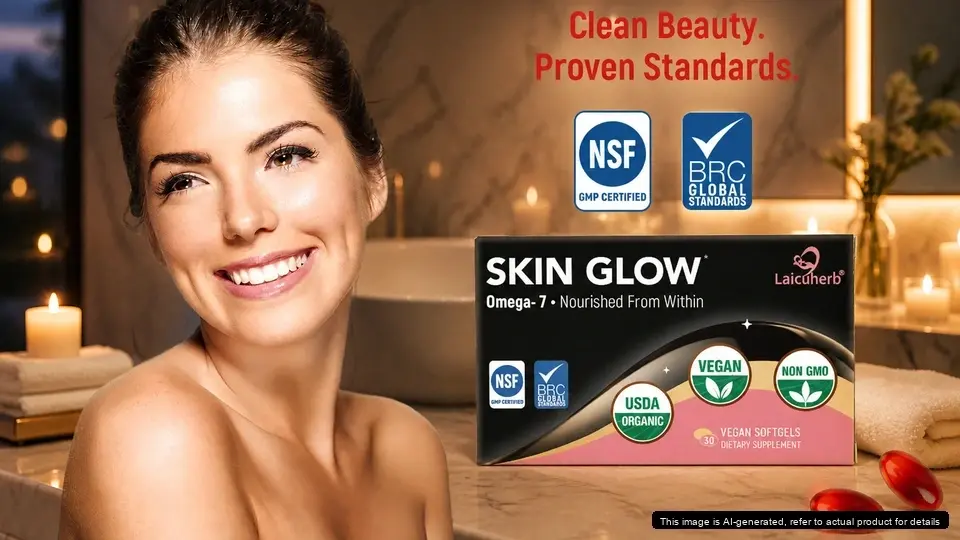
Laicuherb describes its formula as using whole sea buckthorn material and Supercritical CO2 extraction. That is a sourcing and processing detail, not evidence that the finished supplement has the same clinical effect as the study preparation. Batch documents such as a COA can help confirm specified quality characteristics. They do not replace a randomized trial of the exact capsule.
Consumers comparing a skin glow supplement should ask practical questions: What form of sea buckthorn is used? How much oil or palmitoleic acid is provided? What is tested at the batch level? How is the product stored? Are the study dose and product dose actually comparable? The label matters more than the adjective “high-purity.”
What Users Can Realistically Track
Track outcomes that are close to the research question. Skin tightness, flaking, roughness, and comfort are reasonable personal observations. If you want a more structured record, photograph the same area under similar light and note humidity, cleanser, moisturizer, sun exposure, and any new products.
Do not treat a subjective glow rating as a clinical endpoint. Do not use a supplement journal to diagnose eczema or infer that an ingredient is repairing an underlying disease. A few weeks of feeling better may be meaningful to you, but it is not the same as the corneometer and TEWL measurements used in a controlled study.
When Dry, Red, or Irritated Skin Needs Evaluation
Persistent dryness, redness, itching, scaling, burning, pain, cracking, oozing, swelling, or recurrent rash deserves more than a supplement experiment. Eczema, contact dermatitis, psoriasis, rosacea, infection, medication reactions, and other conditions can look like ordinary dryness at first. A skin glow supplement cannot diagnose or treat them.
Seek medical advice if symptoms are severe, spread quickly, interfere with sleep, involve the eyes or mouth, show signs of infection, or do not improve with a basic skincare routine. A dermatologist or other qualified clinician can decide whether testing, prescription treatment, or a different routine is appropriate.
Conclusion
The most useful finding is also the least flashy: oral palmitoleic acid has been studied in a controlled 12-week trial, and the study reported improvements in measured skin hydration and TEWL [1]. That is a promising ingredient result. It is not proof that Laicuherb Skin Glow Supplement will create the same outcome for every user, and it says nothing about treating eczema, dermatitis, or persistent irritation.
Topical moisturizers and oral supplements also answer different questions. A moisturizer acts at the surface. An oral supplement introduces nutrients through digestion and systemic absorption. Neither route automatically wins, and no head-to-head study supports a universal “inside versus outside” verdict.
Laicuherb Skin Glow Supplement is described as a plant-based sea buckthorn formula with naturally occurring Omega-3, Omega-6, omega-7, and Omega-9. Use the product information to understand what you are buying, use the research to keep expectations realistic, and involve a dermatologist when skin symptoms persist. A calm routine beats a miracle claim.

Skin Glow Supplement
100% whole-berry supercritical CO2 extract of organic sea buckthorn. Rich in naturally occurring Omega-7 palmitoleic acid alongside Omega-3, 6, and 9 to support long-lasting stratum corneum moisture and skin barrier integrity.
• Certifications: USDA Organic, NSF cGMP & BRCGS Certified
• Contact Support: hello@laicuherb.com for batch COA papers
LAICUHERB DERMAL INTEGRITY SUMMARY
"Dermal hydration cannot be solved by marketing adjectives. By tracking outcomes scientifically through TEWL and corneometry, we anchor our daily organic routines in verified evidence and realistic dermal support."
About the Author

Dr. Sarah Jenkins, MD, FACOG
Dr. Sarah Jenkins is a Board-Certified OB/GYN with a specialized focus on women's hormonal health, menstrual cycle harmony, and the integration of holistic botanical approaches to reproductive wellness and mucosal hydration.
Frequently Asked Questions
Q1: How long does it take to see results from this supplement?
There is no reliable product-specific timeline for Laicuherb Skin Glow Supplement. The most relevant controlled palmitoleic-acid study measured outcomes at 6 and 12 weeks and found between-group improvements in skin hydration and TEWL at 12 weeks [1]. That does not guarantee that every user will notice a visible change, and it does not prove that a whole sea buckthorn formula has the same effect. Keep the rest of your routine stable when possible and track comfort, tightness, and flaking rather than expecting an instant transformation.
Q2: Can I use this alongside my regular moisturizer?
An oral supplement and a topical moisturizer use different routes, so they can be considered separate parts of a skincare routine. The moisturizer acts directly on the surface. The supplement should not be described as replacing it or as providing the same immediate effect. If you have sensitive skin, a diagnosed condition, take medication, or are pregnant or breastfeeding, ask a qualified healthcare professional whether the supplement is appropriate for you.
Q3: Is this suitable for managing eczema or severe dryness?
No supplement should be presented as a treatment for eczema, dermatitis, or severe dryness. The palmitoleic-acid study enrolled healthy women and did not establish treatment for diagnosed skin disease [1]. Persistent, painful, infected-looking, or worsening skin symptoms need evaluation by a qualified clinician. A supplement may be discussed as general wellness support only after the underlying concern has been assessed.
Scientific References & Literature Support
- Koh, Y. G., Seok, J., Park, J. W., Kim, K. R., Yoo, K. H., Kim, Y. J., & Kim, B. J. (2023). Efficacy and safety of oral palmitoleic acid supplementation for skin barrier improvement: A 12-week, randomized, double-blinded, placebo-controlled study. Heliyon, 9(6), e16711. [DOI: 10.1016/j.heliyon.2023.e16711]
- Mayrovitz, H. N. (2023). Transepidermal water loss and stratum corneum hydration in forearm versus hand palm. Skin Research and Technology, 29, e13218. [DOI: 10.1111/srt.13218]
- Larmo, P. S., Järvinen, R. L., Setälä, N. L., Yang, B., Viikari, J. S. A., Engblom, J. R., & Tahvonen, R. L. (2010). Oral sea buckthorn oil attenuates tear film osmolarity and symptoms in individuals with dry eye. The Journal of Nutrition, 140(8), 1462–1468.