Tea for Women with PCOS: What Helps and What Doesn't






Table of Contents
→ PCOS: Three Main Physiological Patterns
→ Spearmint and Androgen Levels: What Research Actually Shows
→ Cinnamon and Insulin Sensitivity: The Evidence
→ Which Tea Claims Go Beyond the Evidence
→ Laicuherb Blends in a PCOS Context
Search “tea for PCOS” and the internet gets loud fast. Spearmint for testosterone. Cinnamon for insulin. “Hormone balance” blends for the whole cycle. It sounds tidy, and PCOS is not tidy.
Polycystic ovary syndrome is usually a mix of cycle irregularity, androgen-related symptoms, and metabolic risk. The mix is different from one person to the next. That is why a tea can be a drink in your routine, but not the center of your PCOS plan.
Some herbs do have PCOS-relevant research. Spearmint tea has a small human trial in hirsute women with PCOS. Cinnamon has a small randomized trial using 1.5 g/day supplements. Neither finding means a finished herbal tea can diagnose, treat, reverse, or manage PCOS. Laicuherb’s cycle teas should be treated as food-grade herbal beverages for daily ritual and comfort, not hormone treatment.
Quick Answer: Some Herbal Teas Have Studied PCOS-Relevant Mechanisms — But None Are Treatments
The honest answer is narrow. Spearmint tea has been studied for androgen markers in women with hirsutism and PCOS. Cinnamon supplementation has been studied for menstrual cyclicity in a small PCOS trial. Those are interesting signals, not a cure and not a substitute for medical care.
PCOS care starts with diagnosis and a clinician-led plan. The 2023 international evidence-based guideline for PCOS covers assessment and management across reproductive, metabolic, dermatologic, psychological, and lifestyle needs.[1] Depending on symptoms and goals, that may include lifestyle support, combined oral contraceptives, metformin, ovulation induction, anti-androgen therapy, dermatologic care, or fertility care. Tea does not replace any of that.
If a website says tea will “balance hormones,” “reverse PCOS,” “fix insulin resistance,” or “increase fertility,” step back. That is not what the evidence shows.
PCOS: Three Main Physiological Patterns
PCOS is not one symptom. It usually shows up across three overlapping patterns.
The first is ovulatory dysfunction. Cycles may be long, irregular, or hard to predict. Some people do not ovulate regularly, which matters for bleeding patterns and fertility planning.
The second is hyperandrogenism. That can show up as acne, scalp hair thinning, or hirsutism — coarse hair growth on the face, chest, abdomen, or other areas. Blood tests may show higher androgen levels, but visible symptoms matter too.
The third is metabolic risk. Many people with PCOS have insulin resistance or higher risk for weight, lipid, blood pressure, or glucose concerns. Not everyone has the same metabolic profile, and not everyone has the same body size.
A tea cannot tell which pattern is driving your symptoms. That requires medical history, labs when appropriate, and a clinician who understands PCOS. Use that map first. Then decide whether an herbal drink belongs beside your routine.
Spearmint and Androgen Levels: What Research Actually Shows
Spearmint is the herb with the most direct “tea” evidence in this topic. A 30-day randomized controlled trial studied spearmint tea in 42 volunteers with hirsutism and PCOS. Participants drank spearmint tea twice daily. Free and total testosterone decreased over the study period, LH and FSH increased, and self-reported hirsutism improved. Objective Ferriman-Gallwey hirsutism scores did not significantly improve between groups over that short trial.[2]
That last sentence matters. Hair growth changes slowly. A 30-day hormone signal is not the same as visible hair reduction. The study authors themselves noted that the trial was too short to show clear clinical change in hair growth.[2]
What you can say: Spearmint tea has early human evidence for anti-androgen-related markers in PCOS with hirsutism. What you cannot say: That a random PCOS tea lowers androgens, clears acne, removes facial hair, or replaces anti-androgen medication.
Also check the ingredient list. Bloom Tea does not list spearmint on the product page.[6] Do not borrow spearmint evidence for a blend that does not contain spearmint.
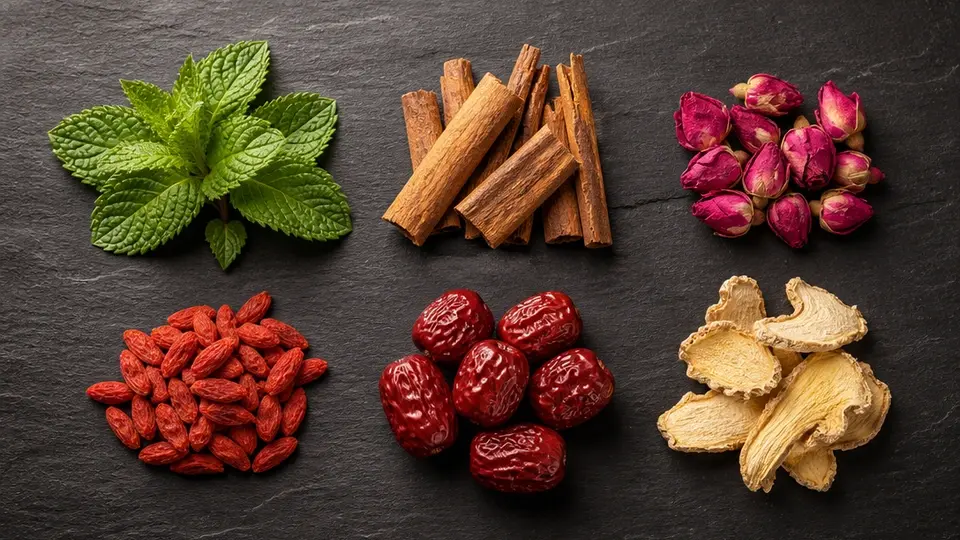
Herbs discussed in PCOS research: spearmint, cinnamon, rose, wolfberry, jujube — each with its own evidence file and dose context.
Cinnamon and Insulin Sensitivity: The Evidence
Cinnamon is often dragged into PCOS content because insulin resistance is common in PCOS. The best-known PCOS cinnamon trial was not a casual cinnamon tea study. It was a double-blind randomized trial of cinnamon supplements at 1.5 g/day for six months in 45 women with PCOS. Only 17 completed the full six months. Cycles were more frequent in the cinnamon group than placebo, but measures of insulin resistance and serum androgen levels did not change in that trial.[3]
That is not nothing. It is also not a license to say cinnamon tea treats insulin resistance.
A brewed cup with a little cinnamon in a blend is not the same as a standardized daily supplement dose. If cinnamon appears in a tea, it can contribute flavor and warmth. It should not be presented as a metformin alternative or as a blood-sugar intervention.
If glucose, insulin resistance, weight changes, or cycle irregularity are the reason you are searching, that belongs in a medical plan. The tea can sit in the evening or morning routine. It should not carry the metabolic workload.
Which Tea Claims Go Beyond the Evidence
Some claims are easy to reject.
A tea cannot cure PCOS. It cannot reverse PCOS. It cannot guarantee ovulation. It cannot replace metformin, hormonal contraceptives, spironolactone, fertility medication, nutrition therapy, or dermatology care. It cannot prove your hormones are balanced because you drank it for a month.
More subtle claims also need trimming. “Supports hormone balance” sounds softer, but with PCOS it still points at a medical outcome. “Detoxes the uterus” is worse; it is vague, biological theater. “Improves fertility” should not be attached to a tea unless the exact finished product has fertility outcome data, and that is not the case here.
Use claims that match the object. A herbal tea can be caffeine-free or caffeinated, warm or light, floral or spicy, phase-positioned, easy to brew, pleasant as a ritual, and made from listed food-grade herbs. It can be part of how someone slows down around their cycle. It is not an endocrine treatment.
Laicuherb Blends in a PCOS Context: What Fits, What to Discuss With Your Doctor
Laicuherb’s Bloom Tea is positioned for the ovulation period and lists Flos Lonicerae, Herb of Flaccid Aster, rose, Rhizoma Zingiberis, brown sugar, Fructus Lycii, and Fructus Jujubae. The product page lists 8 g × 7 bags and includes ISO-FSSC, COI, HALAL, and HACCP certificates.[6]
For PCOS content, the safe way to discuss Bloom is simple: it is an ovulation-phase herbal beverage. If you have PCOS and your cycles are unpredictable, ovulation timing may not be obvious from calendar dates alone. Do not force the tea into a phase if you do not know where you are in the cycle.
Certifications
ISO-FSSC | HACCP | HALAL | COI | COA
This is the part to bring to your clinician: the exact ingredient list, your cycle pattern, medications, pregnancy plans, blood-sugar concerns, and whether you have acne, hirsutism, hair loss, or irregular bleeding. Herbal products can matter in medication reviews, especially if you are pregnant, trying to conceive, taking prescriptions, or managing metabolic conditions.
Product questions can go to hello@laicuherb.com. Medical questions should go to a healthcare professional.
Bloom Tea as a cycle-phase beverage — useful alongside a clinician-led PCOS plan, not as a replacement for one.
Medical Treatments That Should Come First
PCOS is not a “tea first” condition.
Start with diagnosis and risk screening. The international guideline[1] emphasizes broad assessment because PCOS can affect reproductive health, metabolic health, psychological wellbeing, and long-term risk.[4] A clinician may check cycle history, androgen symptoms, glucose or lipid markers, blood pressure, and fertility goals.
Treatment depends on the problem in front of you. Irregular bleeding is not the same as hirsutism. Hirsutism is not the same as insulin resistance. Wanting pregnancy is different from wanting acne control. That is why medical care is not one-size-fits-all.
If your cycles are absent, bleeding is heavy, hair growth is changing quickly, acne is severe, mood is low, or you are trying to conceive — the next step is not a stronger cup. It is proper care.
Conclusion
Tea for PCOS is useful only if the word “for” stays honest.
Spearmint tea has early evidence for androgen markers in a small PCOS hirsutism trial, but not clear objective hair improvement in 30 days.[2] Cinnamon supplements have preliminary evidence for menstrual cyclicity in one small trial, without improved insulin resistance or androgen measures.[3] Bloom Tea is an ovulation-phase beverage, not a PCOS treatment and not a spearmint or cinnamon study.[6]
If a tea makes your routine easier, it can belong beside your plan. It should not become the plan.
FAQ
Q: Can herbal tea cure Polycystic Ovary Syndrome?
No. No herbal tea has been shown to cure, reverse, or treat PCOS. PCOS needs diagnosis and management with a healthcare professional.
Q: Are these health-care teas suitable for cooking or topical use?
No. Laicuherb cycle teas are intended for brewing and drinking as beverages. Do not use them for cooking, baking, or topical application unless the product label specifically says so.
Q: Should I consult my doctor before drinking wellness teas?
Yes if you have PCOS, take medication, are pregnant or trying to conceive, have irregular bleeding, or are managing insulin resistance or other health conditions. Bring the full ingredient list to the visit.
Experience Gentle Cycle Support with Laicuherb
If you are exploring herbal drinks alongside PCOS care, treat them as beverages first. Laicuherb Bloom Tea is an ovulation-phase blend with Flos Lonicerae, Herb of Flaccid Aster, rose, Rhizoma Zingiberis, brown sugar, Fructus Lycii, and Fructus Jujubae in 8 g bags.[6]
Use it only as a cycle-aware ritual if it fits your body and your clinician-led plan. For product ingredients and sourcing, contact hello@laicuherb.com. For PCOS symptoms, medication, fertility, or metabolic questions, work with a healthcare professional.
References
[1] International Evidence-Based Guideline for the Assessment and Management of Polycystic Ovary Syndrome. Monash Centre for Health Research and Implementation. https://www.monash.edu/medicine/mchri/pcos/guideline
[2] Grant, P. (2010). Spearmint herbal tea has significant anti-androgen effects in polycystic ovarian syndrome. Phytotherapy Research, 24(2), 186–188. https://pubmed.ncbi.nlm.nih.gov/19585478/
[3] Kort, D. H., & Lobo, R. A. (2014). Preliminary evidence that cinnamon improves menstrual cyclicity in women with polycystic ovary syndrome. American Journal of Obstetrics and Gynecology, 211(5), 487.e1–487.e6. https://pubmed.ncbi.nlm.nih.gov/24813595/
[4] Teede, H. J., et al. (2023). Recommendations from the 2023 International Evidence-Based Guideline for the Assessment and Management of Polycystic Ovary Syndrome. Human Reproduction. https://academic.oup.com/humrep/...
[5] Azziz, R., et al. (2009). The Androgen Excess and PCOS Society criteria for the polycystic ovary syndrome. Fertility and Sterility, 91(2), 456–488.
[6] Laicuherb. Bloom Hormone Balance Tea. https://www.laicuherb.com/quality-certifications#general-tea-series
Related Readings
Energy Tea vs Matcha: Which Fits a Follicular-Phase Routine?
Luteal Phase Tea and Sleep: What the Evidence Can — and Cannot — Show
|
SJ
|
Dr. Sarah Jenkins Content reviewed for clinical accuracy in PCOS, menstrual health, and herbal supplement evidence. This article does not constitute medical advice. |