What Is Omega-7? A Plain-Language Guide to Palmitoleic Acid






Omega-3 is on almost every fish-oil label. Omega-7 usually is not. If palmitoleic acid has started showing up on a sea buckthorn bottle, it can look like a newly discovered essential fat, when it is actually a monounsaturated fat the body can make, concentrated in one part of one berry.
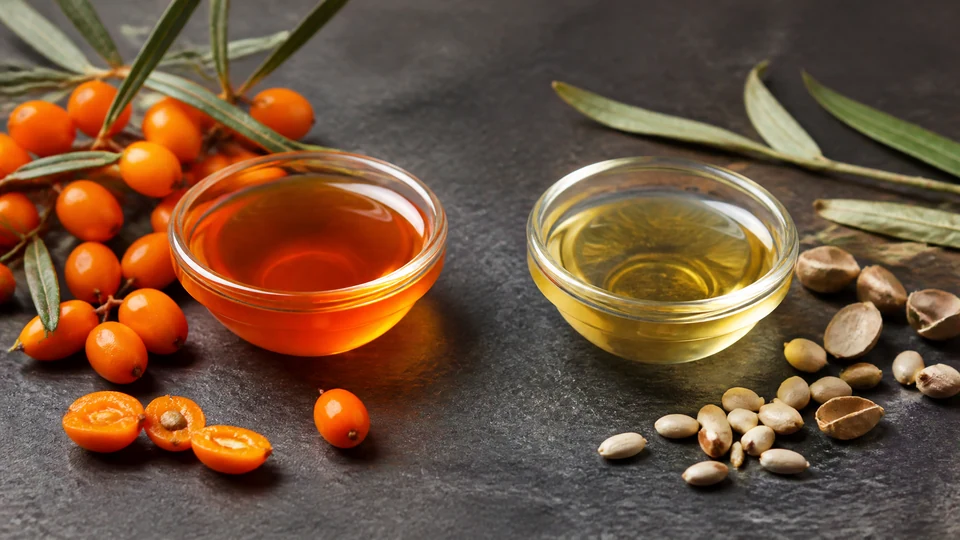
The name is simpler than the marketing. Omega-7 means the first double bond sits seven carbons from the tail of the molecule. Palmitoleic acid is the omega-7 most supplement labels mean. You will find it in sea buckthorn pulp oil, macadamia nuts, and some fish. You will barely find it in sea buckthorn seed oil, which is why two products that both say “sea buckthorn” can contain very different fats.
A useful reading of the label starts there: which omega-7, which plant part, and what the research actually measured. A mouse paper about fat cells making palmitoleic acid is not the same experiment as swallowing an oil.
Table of Contents
2. How Omega Fatty Acids Are Named and Classified →
3. What Palmitoleic Acid Does in the Body →
4. Why Sea Buckthorn Is the Richest Plant Source →
5. Omega-7 vs Omega-3 vs Omega-9: What Each Does →
What Is Omega-7?
Omega-7 is a family of monounsaturated fats. On supplement labels, it almost always means palmitoleic acid, a 16-carbon fat with one double bond (16:1 n-7). Another omega-7, vaccenic acid, shows up mainly in meat and dairy from grazing animals, and those two fats are not interchangeable.
The body can make palmitoleic acid from palmitic acid, so it is not essential in the way alpha-linolenic acid (an omega-3) is. Food still matters because diet changes how much of it you take in, and because sea buckthorn pulp oil is one of the few plant oils that carries a lot of it.
| Omega-7 (palmitoleic acid) | Omega-3 | Omega-9 | |
|---|---|---|---|
| Type of fat | Monounsaturated | Polyunsaturated | Monounsaturated |
| Essential? | No. The body can make it | ALA is essential; EPA and DHA usually come from fish or algae | No. The body can make it |
| Common food sources | Sea buckthorn pulp oil, macadamia, some fish | Fatty fish, flax, chia, walnuts, algae | Olive oil, avocado, many nuts |
| What a label is usually selling | Palmitoleic acid, often from sea buckthorn | EPA, DHA, or ALA | Oleic acid, often from olive oil |
Macadamia oil is a real plant source of palmitoleic acid, though it is mostly oleic acid, with palmitoleic acid often in the mid-teens to high twenties as a percentage of the oil. Sea buckthorn pulp oil is the plant oil actually built around palmitoleic acid. Sea buckthorn seed oil is not.
How Omega Fatty Acids Are Named and Classified
The number tells you where the first double bond sits, counting from the methyl end of the chain, the tail that is not the acid end. In an omega-7 that bond sits at carbon 7, in an omega-3 at carbon 3, and in an omega-9 at carbon 9.
That location changes the shape of the fat, and the shape changes how it sits in membranes. Omega-7 and omega-9 have one double bond, so they are monounsaturated. Omega-3 and omega-6 have more than one, so they are polyunsaturated and more chemically reactive. The numbering does not rank them; it only tells you they are different fats.
If a bottle lists omega-3, 6, 7, and 9 together, read the amounts. A whole-berry sea buckthorn oil can contain all four because the seed and the pulp are different oils. A seed-only oil will look like an omega-3/6 product wearing a sea buckthorn name.
What Palmitoleic Acid Does in the Body
Palmitoleic acid in your blood is not automatically the same thing as palmitoleic acid in a capsule.
In 2008, a mouse study in *Cell* described palmitoleic acid made inside fat tissue as a lipokine: a fat that can leave adipose tissue and talk to other organs. That paper is real, and it is widely copied onto supplement pages. It measured a signal the animals produced themselves. It did not prove that eating palmitoleic acid recreates the same signal in people. Later reviews still treat that human leap as unproven.
Mouse feeding studies are more modest than the headlines. Yang, Miyahara, and Hatanaka (2011) found that giving palmitoleic acid to a diabetic mouse strain reduced liver fat and improved insulin-related markers in that model. That is a reason researchers keep looking. It is not a reason to say omega-7 treats metabolic syndrome.
Human work is smaller and more specific. Palmitoleic acid is already part of sebum, the skin’s own oil. Oral sea buckthorn oil has been studied for tear-film comfort. A 12-week randomized trial of oral palmitoleic acid reported changes in skin-barrier measurements. Those studies support talking about moisture and comfort, not about treating a skin disease or replacing a prescribed lipid plan.
Why Sea Buckthorn Is the Richest Plant Source
That claim holds only for the pulp, not the seed.
The orange flesh of the berry yields an oil that is unusually high in palmitoleic acid. Analyses of berries from different origins have put pulp-oil palmitoleic acid in a wide range, often around 30 percent of the fatty acids and sometimes higher. The seed oil is a different product. It is dominated by linoleic acid (omega-6) and alpha-linolenic acid (omega-3). Palmitoleic acid in seed oil is typically a trace.
That split is the shopping fact most pages skip. “Sea buckthorn oil” on a label can mean pulp oil, seed oil, or a blend of both. If the reason you picked the bottle was omega-7, the pulp has to be in the oil. A whole-berry extract is one way to keep both profiles. It is not automatically a higher dose of palmitoleic acid than a pulp-only oil.
Macadamia does not lose because it also contains palmitic acid. Sea buckthorn pulp oil contains a lot of palmitic acid too. The difference is the mix: macadamia is an oleic-acid oil with some palmitoleic acid; pulp oil is one of the few plant oils where palmitoleic acid is a major fat.
Wild Himalayan berries versus farmed berries is a origin story, not a fatty-acid proof. Variety, ripeness, and which part of the fruit was pressed change the numbers more than a mountain adjective does. The label should show palmitoleic acid in milligrams, not just the word omega-7.
Omega-7 vs Omega-3 vs Omega-9: What Each Does
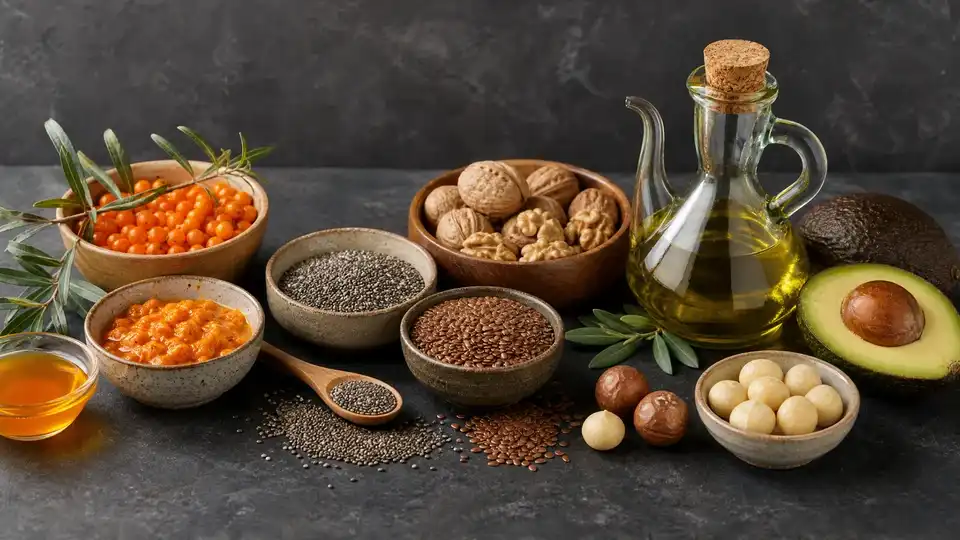
Omega-3, especially EPA and DHA from fish or algae, has the largest human evidence base among the common supplement omegas. People take it when they want those specific fats, not when they want palmitoleic acid.
Omega-9, mainly oleic acid, is the everyday monounsaturated fat in olive oil and many nuts. It is easy to get from food. A supplement is rarely the only way to meet it.
Omega-7 does not cover the jobs those two already do. It does not replace EPA. It does not make olive oil irrelevant. Palmitoleic acid is being studied for skin lipids, mucosal comfort, and metabolic markers. The research is smaller, and a lot of the metabolic story still sits in cells and animals.
A broad-spectrum sea buckthorn oil can contain omega-3, 6, 7, and 9 because the seed and pulp contribute different fats. That is a blend, not a reason to skip a dedicated EPA/DHA source if that is the fat you actually wanted.
Who Might Benefit From Supplementing
“Benefit” here means a nutritional gap, not a diagnosis.
Someone who wants a plant source of palmitoleic acid, and who does not eat macadamia oil in quantity, may look at sea buckthorn pulp or whole-berry oil. Someone comparing bottles because of dry skin or dry mouth is looking at lipid building blocks and comfort, not at a treatment for a named disease. Someone avoiding fish is looking at a plant oil, not at a vegetarian version of fish oil. Sea buckthorn does not supply EPA and DHA the way algal oil or fish oil does.
It is a poor fit as a stand-in for medical care, as a cure for metabolic syndrome, or as a product you start during pregnancy, before surgery, or on blood thinners without asking a clinician. Fatty-acid supplements still go through the same body that processes everything else you swallow.
Conclusion
Omega-7 on a label is almost always palmitoleic acid: a monounsaturated fat the body can make, and a fat that is unusually high in sea buckthorn pulp oil. The lipokine story comes from fat cells in mice. The shopping story is simpler. Read the plant part, read the milligrams, and do not treat a berry oil as fish oil or as a prescription.
READ THE LABEL FIRST
Read the plant part, read the palmitoleic acid amount, and keep research findings separate from treatment claims.
FAQ
Q: 1. Is omega-7 the same as omega-3?
A: No. Omega-7 (palmitoleic acid) is monounsaturated and non-essential. Omega-3 includes ALA, which is essential, and EPA and DHA, which usually come from fish or algae. They are not substitutes.
Q: 2. Why does whole-berry sea buckthorn oil differ from seed oil?
A: The seed is mostly omega-3 and omega-6. The pulp is where most of the palmitoleic acid sits. A whole-berry oil mixes both. A seed-only oil is a weak omega-7 source.
Q: 3. Does omega-7 treat dry skin?
A: There is no basis for saying it treats a medical skin disease. Palmitoleic acid is already part of sebum, and some oral studies have looked at barrier and moisture measurements. That is nutritional support for the lipid layer, not a dermatology protocol.
Q: 4. Can the body make omega-7 without a supplement?
A: Yes. Palmitoleic acid can be made from palmitic acid. Food and supplements change how much you take in. They are not the only source in the body.
Q: 5. Is macadamia oil enough if I want omega-7?
A: Macadamia oil contains palmitoleic acid, but oleic acid is still the main fat. If the goal is a plant oil in which palmitoleic acid is a major component, sea buckthorn pulp oil is the closer match.
References
1. Cao, H., Gerhold, K., Mayers, J. R., Wiest, M. M., Watkins, S. M., & Lodish, H. F. (2008). Identification of a lipokine, a lipid hormone linking adipose tissue to systemic metabolism. Cell, 134(6), 933–944. Verified source
2. Yang, Z. H., Miyahara, H., & Hatanaka, A. (2011). Chronic administration of palmitoleic acid reduces insulin resistance and hepatic lipid accumulation in KK-Ay mice with genetic type 2 diabetes. Lipids in Health and Disease, 10, 120. Verified source
3. Bermúdez, M. A., Pereira, L., Fraile, C., Valerio, L., Balboa, M. A., & Balsinde, J. (2022). Roles of palmitoleic acid and its positional isomers, hypogeic and sapienic acids, in inflammation, metabolic diseases and cancer. Cells, 11(14), 2146. Verified source
4. Yang, B., & Kallio, H. P. (2001). Fatty acid composition of lipids in sea buckthorn (Hippophaë rhamnoides L.) berries of different origins. Journal of Agricultural and Food Chemistry, 49(4), 1939–1947.
5. Koh, Y. G., Seok, J., Park, J. W., Kim, K. R., Yoo, K. H., Kim, Y. J., & Kim, B. J. (2023). Efficacy and safety of oral palmitoleic acid supplementation for skin barrier improvement: A 12-week, randomized, double-blinded, placebo-controlled study. Heliyon, 9(6), e16711. Verified source
6. Järvinen, R. L., Larmo, P. S., Setälä, N. L., Yang, B., Engblom, J. R., Viitanen, M. H., & Kallio, H. P. (2011). Effects of oral sea buckthorn oil on tear film fatty acids in individuals with dry eye. Cornea, 30(9), 1013–1019.
Related Readings
Who Should Always Check With a Doctor Before Taking Herbal Supplements?
Chinese Herbal Medicine and Modern Supplements: Understanding the Difference
Herbal Tea and Male Fertility: What the Research Says
Source note: Content preserved from the supplied artifact.md file. No original article URL was supplied.