What to Eat and Avoid While Taking Sea Buckthorn Oil






A sea buckthorn oil capsule is still an oil. If you swallow it with water and a bowl of fruit, you have not given your gut much fat to work with. That is the main meal question. It is not a reason to rebuild your entire diet around a supplement.
The fats and orange pigments in the oil mix with other fats in a meal. They do not mix well with water. A modest amount of food fat — eggs, avocado, olive oil, nuts, yogurt, or fish — is enough for most people. You do not need a “fat-loading” protocol.
The other question is safety, not absorption. If you take a prescription blood thinner, do not treat garlic, ginger, or this oil as a home experiment. Ask the clinician who already manages that medicine. Everyday cooking amounts are not the same thing as high-dose supplements stacked on top of warfarin or aspirin.
Table of Contents
1. Should You Take Sea Buckthorn Oil With Food? →
2. Foods That Help Absorption →
3. Foods That Make Absorption Harder →
Should You Take Sea Buckthorn Oil With Food?
Yes. Take it with a meal that already contains some fat. The omega fatty acids, carotenoids, and vitamin E in sea buckthorn oil are fat-soluble. When fat from food reaches the small intestine, bile and digestive enzymes can break the oil into droplets the gut can take up.
That meal effect is well described for other fat-soluble nutrients. Fish-oil ethyl esters were absorbed better with a high-fat meal than without one. Vitamin D-3 reached a higher blood peak when taken with a fat-containing breakfast than with a fat-free one. Those papers are not sea buckthorn trials. They are the reason an empty-stomach week is a poor test of the capsule you bought.
A labeled serving of oil is a small fat load next to breakfast or dinner. On its own it may not be much of a signal. Pairing it with food fat is the conservative habit. Clock time matters less than that pairing. Use the meal you will actually eat with fat, most days.
Foods That Help Absorption
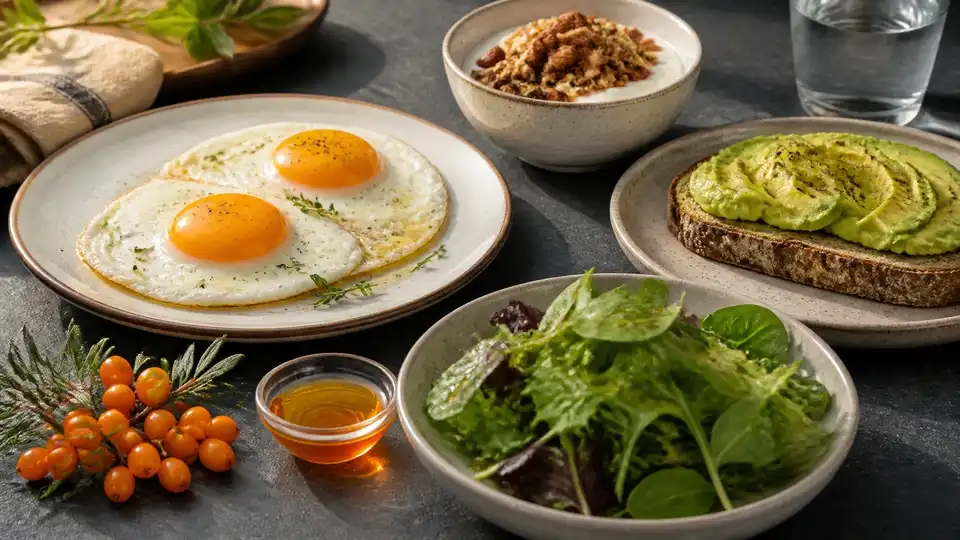
You are looking for ordinary dietary fat, not a special “omega-7 food.” Avocado, olive oil, eggs, full-fat yogurt, nuts, seeds, cheese, and fatty fish all count. A drizzle of oil on vegetables or a handful of almonds on oatmeal is enough to change a low-fat plate into a usable one.
The oil does not replace those foods. It is a small extra dose of plant fat. You still need meal fat to move the capsule along. Sea buckthorn also does not replace fish or algal oil if what you wanted was EPA and DHA. Whole-berry oil can carry omega-3 as alpha-linolenic acid from the seed, plus palmitoleic acid (omega-7) from the pulp. Those are different fats.
If mornings are coffee and toast with nothing on it, wait for the meal that has oil, nuts, or eggs. If breakfast already has yogurt or eggs, put the capsule there. A few people get an oily aftertaste from any oil capsule; taking it with the larger meal often makes that quieter.
Foods That Make Absorption Harder
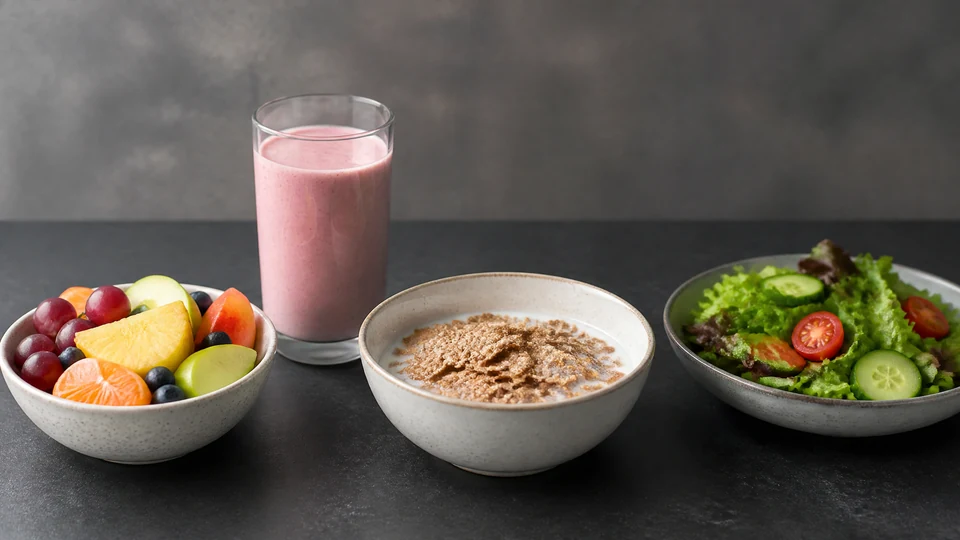
The problem plate is not “vegetables.” It is a meal with almost no fat: a plain fruit bowl, a fat-free smoothie, dry cereal with skim milk, or a salad with no dressing.
Those meals can be healthy. They are a weak partner for a fat-soluble oil. Uptake is likely to be lower, and stomach discomfort is more common, which is a poor way to judge the capsule.
Coffee does not cancel the oil. Neither does tea. Alcohol is a separate issue if you take blood thinners; it is not an absorption blocker in the way a fat-free breakfast is. High-dose fiber drinks or fat-blocking medicines such as orlistat can interfere with fat uptake. If you use those, ask a pharmacist how to space an oil capsule.
You do not need to avoid tomatoes, citrus, or leafy greens. Pair them with oil or another fat if that plate is the one that carries the capsule.
Blood Thinners, Garlic, and Ginger
Sea buckthorn oil is not a proven blood thinner. High-dose marine omega-3 (EPA and DHA) is the fatty-acid story that shows up in bleeding cautions. Whole-berry sea buckthorn oil is a different mix, and it is usually low in EPA and DHA. Do not copy fish-oil rules onto this bottle and call it proof.
If you take warfarin, aspirin, clopidogrel, a direct oral anticoagulant, or another medicine that affects clotting, the useful move is still a medication review. Bring the actual label. Do not start, stop, or restack supplements based on a meal chart.
Garlic, ginger, turmeric, ginkgo, and high-dose vitamin E appear on many “natural blood thinner” lists. Culinary amounts in food are not the same as concentrated capsules. Keep garlic in ordinary cooking unless a clinician has told you otherwise. Do not pile high-dose herb capsules on top of a prescription without asking the person who prescribed it.
Unusual bruising, nosebleeds that are hard to stop, blood in stool or urine, or a planned surgery are reasons to call a clinician, not reasons to rewrite your grocery list from a blog.
A Simple Day of Meals
Breakfast can be eggs cooked in olive oil, or yogurt with nuts, or toast with avocado. Swallow the capsule with that plate.
Lunch can be a salad if the dressing actually contains oil, or if there is cheese, salmon, or a handful of walnuts on it. A fat-free salad is the plate to fix, not the vegetables.
Dinner can be any meal you already eat with oil, butter, nuts, or fatty fish. You do not need flax oil on every vegetable. You need some fat present when you take the capsule.
If you eat almost no fat, fast for long windows, or take medicines that change how meals work, ask the clinician who already follows those rules. Meal pairing is a habit. It is not medical nutrition therapy.
Conclusion
Take sea buckthorn oil with a meal that contains fat. Skip the fat-free breakfast as your test run. Keep garlic and ginger in ordinary cooking unless a clinician has told you otherwise. If you take a blood thinner, the food question is second; the first question is whether this supplement belongs next to that prescription at all.
PAIR THE CAPSULE WITH THE MEAL
Use ordinary dietary fat as the practical meal partner. If a prescription blood thinner or a medication that changes fat uptake is involved, ask the clinician or pharmacist before changing your supplement routine.
FAQ
Q: 1. Can I take sea buckthorn oil on an empty stomach?
A: It is a poor habit. Fat-soluble fats and carotenoids are taken up better with dietary fat, and empty-stomach oil capsules are more likely to sit badly. Use a meal that already has some fat.
Q: 2. Does the supplement replace dietary fats?
A: No. The capsule is a small amount of oil. Meal fat is still what helps move it through digestion.
Q: 3. Do I need to avoid garlic and ginger?
A: Not as food, for most people. If you take a prescription blood thinner, ask your clinician before adding high-dose garlic, ginger, ginkgo, or vitamin E capsules. Cooking with those spices is not the same decision.
Q: 4. Why does whole-berry oil differ from seed oil at the table?
A: The seed is mostly omega-3 and omega-6. The pulp is where most of the palmitoleic acid (omega-7) sits. That is a label fact. It does not change the meal rule: both oils still want dietary fat.
Q: 5. Will coffee or alcohol block absorption?
A: Coffee is not an absorption blocker here. Alcohol does not replace the fat-meal rule, and it is a separate caution if you take blood thinners.
References
1. Lawson, L. D., & Hughes, B. G. (1988). Absorption of eicosapentaenoic acid and docosahexaenoic acid from fish oil triacylglycerols or fish oil ethyl esters co-ingested with a high-fat meal. Biochemical and Biophysical Research Communications, 156(2), 960–963.
2. Dawson-Hughes, B., Harris, S. S., Lichtenstein, A. H., Dolnikowski, G., Palermo, N. J., & Rasmussen, H. (2015). Dietary fat increases vitamin D-3 absorption. Journal of the Academy of Nutrition and Dietetics, 115(2), 225–230. Verified source
3. Office of Dietary Supplements, National Institutes of Health. Omega-3 Fatty Acids: Fact Sheet for Consumers. Verified source
4. Mayo Clinic. Herbal supplements and heart medicines may not mix. Verified source
5. Yang, B., & Kallio, H. P. (2001). Fatty acid composition of lipids in sea buckthorn (Hippophaë rhamnoides L.) berries of different origins. Journal of Agricultural and Food Chemistry, 49(4), 1939–1947.
6. U.S. Food and Drug Administration. Questions and Answers on Dietary Supplements. Verified source
Related Readings
The Science of Cycle Syncing: What Research Actually Supports
What Is Omega-7? A Plain-Language Guide to Palmitoleic Acid
Who Should Always Check With a Doctor Before Taking Herbal Supplements?